
Did you know that 70% of digital marketers fail to achieve consistent growth because they rely on intuition rather than data? In the competitive 2026 digital landscape, your ability to convert visitors into loyal customers depends on precision. Systematic experimentation is no longer optional; it is the primary engine for sustainable revenue.
This guide explores the professional standards required for modern conversion rate optimization. By mastering Landing Page Testing, you gain the power to identify exactly what drives your audience to act. We will walk you through the essential frameworks needed to scale your results effectively.
You will discover how landing page a/b testing serves as the foundation for your long-term success. Prepare to transform your digital presence through rigorous, evidence-based strategies that deliver measurable impact.
Key Takeaways
- Data-driven decisions outperform intuition in modern digital marketing.
- Systematic experimentation is essential for sustainable business growth.
- Conversion rate optimization requires a professional and structured approach.
- Testing helps identify specific user behaviors that drive higher engagement.
- Evidence-based strategies are the key to long-term digital success.
Turn Data Into Growth
Turn landing page guesswork into measurable growth with structured A/B testing that reveals what converts visitors and helps you maximize every opportunity across your campaigns.
The Fundamentals of Landing Page Testing
Modern marketing teams rely on rigorous experimentation and landing page testing to turn casual visitors into loyal customers. By prioritizing Landing Page Testing, you move away from guesswork and toward a strategy rooted in actual user behavior. This shift ensures that every design choice serves a specific purpose in your sales funnel.
Why Testing Matters for Conversion Rates
Landing page testing helps you move beyond intuition and identify which elements truly resonate with your target audience. When you implement structured landing page tests, you gain objective insights into what truly drives your visitors to take action. This process allows you to identify friction points that might be preventing potential customers from completing a purchase or signing up for a service.
Continuous optimization provides a significant competitive advantage in a crowded digital marketplace. By systematically refining your pages, you can achieve higher conversion rates without necessarily increasing your advertising spend. This efficiency is the hallmark of a high-performing marketing department that values data over assumptions.
Defining Success Metrics and Key Performance Indicators
To measure the effectiveness of your efforts, you must establish clear benchmarks before launching any experiment. Tracking the right metrics ensures that your Landing Page Testing efforts align with your broader business objectives. Without these indicators, you risk optimizing your landing page testing efforts around vanity metrics that do not contribute to your bottom line.
The following table outlines the essential metrics you should monitor to gauge the health and performance of your pages.
| Metric | Definition | Business Impact |
|---|---|---|
| Conversion Rate | Percentage of visitors who complete a goal. | Directly measures campaign success. |
| Bounce Rate | Visitors who leave after one page view. | Indicates relevance and page speed. |
| Average Order Value | Mean amount spent per transaction. | Reflects revenue growth potential. |
| Cost Per Acquisition | Total spend divided by new customers. | Determines overall marketing efficiency. |
Focusing on these specific indicators allows you to make informed decisions that drive sustainable growth. By consistently reviewing these data points, you can refine your strategy and ensure that your digital presence remains optimized for maximum impact.
Strategic Planning for Landing Page A/B Testing
Strategic planning serves as the essential blueprint for every successful conversion rate optimization project. You must move beyond guesswork to ensure your efforts yield measurable growth. By grounding your decisions in hard data, you transform your website into a high-performing asset.
Identifying High-Impact Pages for Testing
Not every page on your site deserves the same level of attention. You should focus your Landing Page Testing on areas that drive the most revenue or capture the most leads. Start by reviewing your analytics to find pages with high traffic but disappointing conversion rates.
High bounce rates on key landing pages often signal a disconnect that landing page testing can help identify between user expectations and your content. Prioritize these pages to see the fastest return on your investment. Use the following criteria to rank your pages for upcoming experiments:
| Page Type | Traffic Volume | Conversion Potential | Priority Level |
|---|---|---|---|
| Product Landing Page | High | High | Critical |
| Newsletter Signup | Medium | Medium | Moderate |
| About Us Page | Low | Low | Low |
Formulating Hypotheses Based on User Behavior
Once you select a page, you must create a clear hypothesis for your landing page testing campaign. A strong hypothesis connects a specific change to an expected outcome based on observed user behavior. Avoid testing random elements; instead, focus on solving specific friction points identified in your session recordings or heatmaps.
“A hypothesis is not just a guess; it is a logical prediction based on data that guides your entire testing process.”
When you conduct landing page tests, ensure your hypothesis follows a simple structure. State what you will change, why you believe it will work, and what metric you expect to improve. This clarity keeps your team aligned and prevents scope creep during the experiment.
Determining Sample Size and Statistical Significance
Mathematical rigor is the backbone of reliable Landing Page Testing. You must calculate the required sample size before starting to avoid making decisions based on incomplete data. Running landing page tests without reaching statistical significance often leads to false positives and wasted resources.
Statistical significance ensures that your landing page testing results are not due to random chance. Use online calculators to determine how many visitors you need to reach a confidence level of at least 95%. By waiting for the data to mature, you gain the confidence to implement changes that truly drive long-term growth.
Essential Elements to Test on Your Landing Pages
When you begin your journey into a/b testing landing pages, identifying the right variables is your first step toward success. Not every element on your site holds the same power to influence visitor behavior. By focusing on high-impact components, you can make data-driven decisions that significantly improve your conversion rates.
Optimizing Headlines and Value Propositions
Your headline is often the first thing a visitor sees, making it the most critical piece of real estate on your page. A strong value proposition clearly communicates the benefit of your offer within seconds. Through landing page testing, you should test different angles, such as focusing on pain points versus highlighting specific product features.
Testing Call to Action Button Copy and Placement
The call to action (CTA) serves as the bridge between interest and conversion. Small changes to button text, such as switching from “Submit” to “Get My Free Guide,” can lead to surprising shifts in engagement. Furthermore, landing page testing of these buttons, whether above the fold or at the end of a long-form page, helps you understand where your users are most ready to commit.
Optimize What Converts
Test headlines, CTAs, forms, and layouts with confidence to uncover winning variations, reduce friction, and create experiences that drive more qualified conversions for your business.
Evaluating Visual Hierarchy and Imagery
Visual elements guide the user’s eye toward your most important content. When conducting landing page tests, you must evaluate how images and layout structures direct attention. High-quality imagery that aligns with your brand message often builds trust faster than generic stock photos.
Impact of Hero Section Layouts
The hero section sets the tone for the entire user experience. Experimenting with different layouts, such as placing text on the left versus the right, can change how quickly a user grasps your message. Consistency in design is vital, but testing the balance between white space and content is equally important for reducing friction.
Testing Form Length and Field Requirements
Forms are often the biggest source of friction on a landing page, making them an important focus for landing page testing. You should test whether reducing the number of required fields increases your completion rate. Sometimes, asking for less information upfront encourages more users to start the process, which you can then follow up on later.
| Element Type | Primary Goal | Testing Difficulty | Expected Impact |
|---|---|---|---|
| Headlines | Clarity & Interest | Low | High |
| CTA Buttons | Click-Through Rate | Low | Medium |
| Form Fields | Lead Quality | Medium | High |
| Hero Imagery | Brand Trust | High | Medium |
By systematically running landing page tests, you gain a deeper understanding of what motivates your specific audience. Remember that a/b testing landing pages is an ongoing process of refinement. Always document your findings to ensure that every test informs your future marketing strategy.
Selecting the Right Landing Page Testing Software
Your ability to run effective landing page testing experiments depends heavily on the software you select. Choosing the correct technology stack is vital for executing complex a/b testing landing pages without encountering technical bottlenecks. A well-chosen platform empowers your team to make data-driven decisions with confidence.
Key Features to Look for in Testing Tools
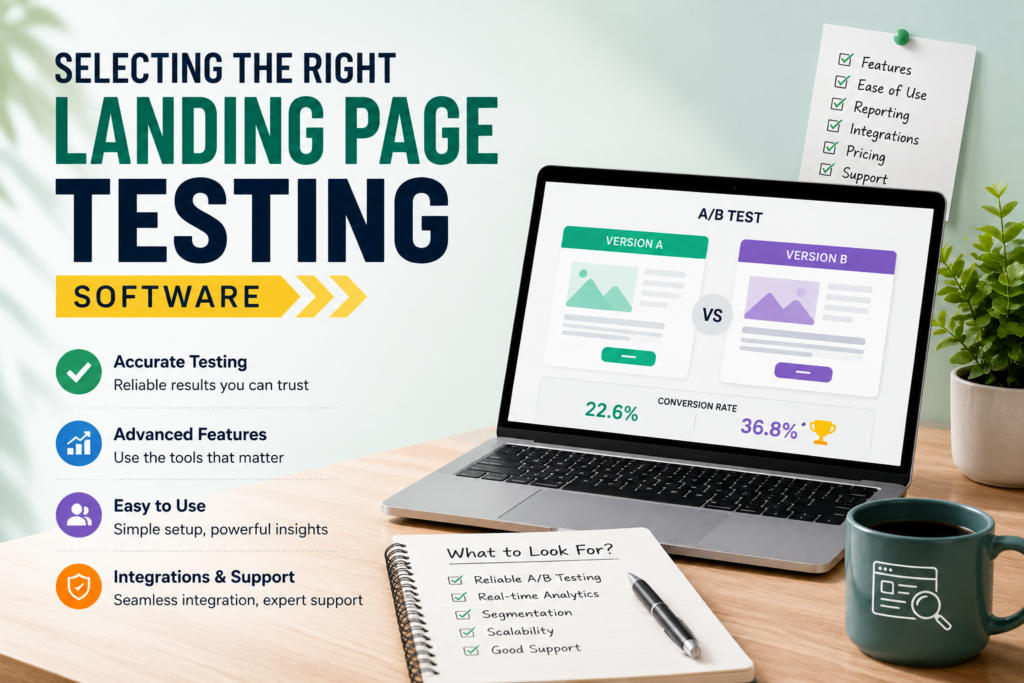
When evaluating landing page testing software, prioritize tools that offer intuitive interfaces and robust reporting. You need a solution that provides real-time data processing to monitor performance shifts as they happen. Look for platforms that support advanced segmentation, allowing you to analyze how different user groups interact with your variations.
Reliability is another cornerstone of high-quality testing tools. Ensure the software provides statistical significance calculators to prevent false positives in your results. A tool that simplifies the setup process will save your team valuable time and reduce the risk of human error during deployment.
Comparing Top Platforms like Optimizely and VWO
The market offers several powerful options for landing page a/b testing, with Optimizely and VWO standing out as industry leaders. Optimizely is often favored by enterprise-level organizations for its sophisticated experimentation engine and scalability. VWO, on the other hand, is frequently praised for its user-friendly visual editor and comprehensive heatmapping capabilities.
| Feature | Optimizely | VWO |
|---|---|---|
| Ease of Use | Moderate | High |
| Advanced Analytics | Excellent | Strong |
| Enterprise Scaling | Superior | Good |
| Pricing Model | Custom/High | Tiered/Flexible |
Integrating Testing Tools with Your Landing Page Builders
Seamless integration is essential for maintaining a smooth workflow. Many modern landing page builders with a/b testing capabilities allow for native connections to third-party analytics tools. This connectivity ensures that your conversion data flows accurately between your landing page and your testing dashboard.
Before committing to a platform, verify that it supports your current tech stack. A strong integration reduces the need for custom coding and allows you to launch experiments faster. Always test the connection in a staging environment to ensure that tracking pixels and scripts fire correctly across all variations.
How to A/B Test Landing Pages Effectively
Launching your first experiment is a pivotal moment in your conversion optimization journey. When you commit to a data-driven culture, you move beyond guesswork and start making decisions based on actual user behavior. Utilizing professional landing page testing software ensures that your experiments remain accurate and reliable throughout the entire process.
Setting Up Your First Split Test
To begin, you must define a clear objective for your experiment. Whether you want to increase sign-ups or improve click-through rates, your goal should be measurable and specific. Once your goal is set, follow these steps to initiate your test:
- Select a single variable to change, such as a headline or button color.
- Create a variation that differs significantly from your original control page.
- Configure your landing page testing software to track specific conversion events.
- Launch the test and allow it to run until you reach statistical significance.
Managing Traffic Allocation and Redirects
Proper traffic management is essential when you learn how to a/b test landing pages and manage landing page testing campaigns effectively. You need to ensure that visitors are distributed evenly between your control and variation pages to avoid skewed results. Most modern platforms handle this through server-side or client-side redirects.
Consistent user experience is vital during this phase. If a user visits your site multiple times, they should see the same version of the page every time. This prevents confusion and maintains the integrity of your data collection.
Running Concurrent Tests Without Data Contamination
Many marketers wonder how to a/b test landing pages when they have multiple campaigns running simultaneously. The biggest risk here is data contamination, where one test influences the outcome of another. To mitigate this, you must isolate your landing page testing environments effectively.
Follow these best practices to keep your experiments clean:
- Avoid running multiple tests on the same page at the same time.
- Use unique URL parameters to segment traffic for different experiments.
- Document every active test to ensure your team understands the current landscape.
- Prioritize a/b testing landing pages that have the highest traffic volume to get faster results.
By maintaining strict control over your experimental environment, you protect the validity of your findings. Consistent a/b testing landing pages will eventually provide you with a roadmap for continuous growth and improved conversion rates.
Common Pitfalls in Landing Page Split Testing
Mastering the art of landing page split testing involves avoiding common traps that skew your metrics. Even the most seasoned digital marketers can stumble when optimizing their conversion funnels. By identifying these errors early, you ensure your data remains reliable and actionable.
Avoiding Premature Conclusion of Tests
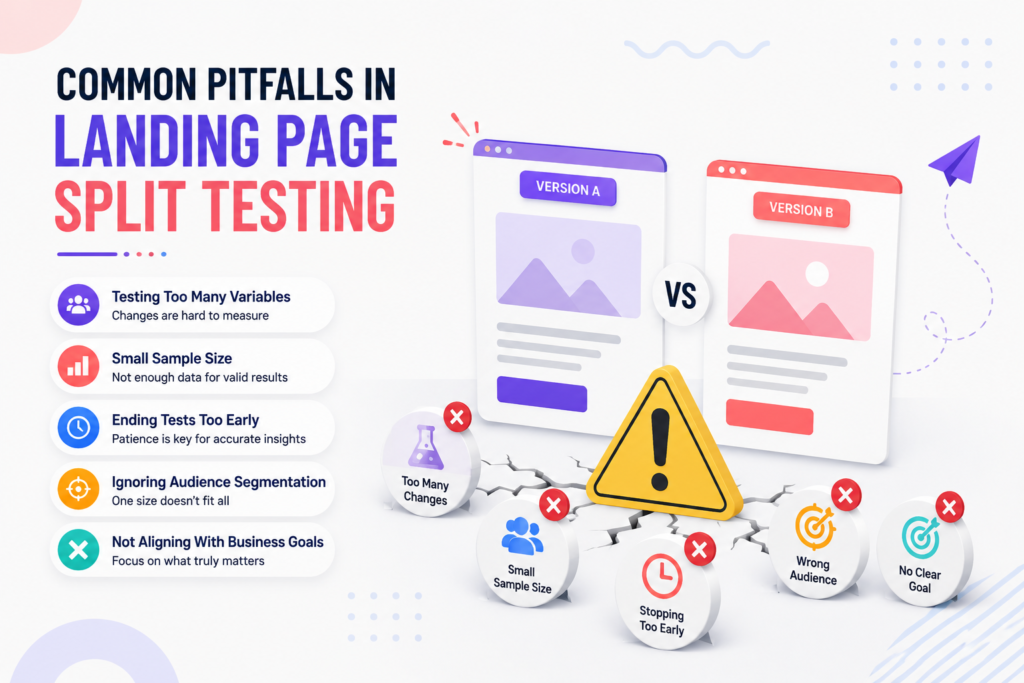
One of the most frequent mistakes is stopping a test before it reaches statistical significance. You might feel tempted to declare a winner when you see a sudden spike in conversions. However, early termination often leads to false positives that do not hold up over time.
Always allow your landing page testing software to run until it reaches a sufficient sample size. Patience is your greatest asset when learning how to a/b test landing pages effectively. Rushing the process often results in implementing changes that fail to deliver long-term growth.
The Danger of Testing Too Many Variables Simultaneously
It is tempting to overhaul an entire page design to see what works best. Unfortunately, testing too many elements at once makes it impossible to isolate which specific change drove the improvement. This approach muddies your data and leaves you guessing about user preferences.
Focus on testing one or two high-impact variables, such as your headline or call-to-action button. This disciplined strategy provides clear, actionable insights that you can apply to future campaigns. When you isolate variables, you gain a deeper understanding of your audience’s behavior.
Ignoring Mobile User Experience Discrepancies
Many marketers focus heavily on desktop performance while neglecting the mobile experience. If your mobile users face friction, your overall conversion rate will suffer regardless of your desktop optimizations. You must segment your data to see how different devices interact with your variations.
Mobile users often have different intent and navigation habits compared to desktop users. By analyzing these discrepancies, you can refine your mobile layout to better serve your visitors. Using the right landing page testing software allows you to view these segments separately, ensuring a seamless experience across all platforms.
Advanced Techniques for Landing Page Optimization
Moving beyond simple tests allows you to uncover deeper insights into how your visitors interact with your site. While you may already know how to a/b test landing pages, advanced methods provide a more granular view of user behavior. These landing page testing strategies help you refine your digital presence to maximize every visitor interaction.
Multivariate Testing for Complex Page Layouts
Multivariate testing (MVT) takes your optimization efforts to the next level by testing multiple variables at once. Instead of changing one element, you can test various combinations of headlines, images, and button colors simultaneously. This approach is ideal for high-traffic pages where you need to find the perfect balance of design elements.
By analyzing these combinations, you identify which specific components drive the highest engagement. This method is far more efficient than running dozens of individual tests sequentially. It provides a comprehensive map of what truly resonates with your audience.
Personalization Strategies Based on Traffic Sources
Your visitors arrive from diverse channels, each with unique expectations and intent. You can significantly improve your conversion rates by tailoring your landing page content to match the source of your traffic. For instance, a visitor coming from a LinkedIn ad may require a different tone than one arriving from a Google search.
“Personalization is not just a trend; it is the fundamental requirement for modern digital marketing success.”
Implementing dynamic content allows you to swap headlines or offers based on the user’s referral path. This level of customization makes your landing page split testing efforts more relevant and effective. When users see content that aligns with their specific needs, they are much more likely to convert.
Using Heatmaps and Session Recordings to Inform Tests
Quantitative data tells you what is happening, but qualitative data explains why. Heatmaps provide a visual representation of where users click, scroll, and linger on your page. By observing these patterns, you can identify friction points that standard metrics might miss.
Session recordings offer a “fly-on-the-wall” perspective of the user journey. You can watch exactly how visitors navigate your site and where they encounter confusion. Integrating these insights into your landing page split testing strategy ensures that you are solving real problems rather than guessing at solutions. Data-driven decisions are the hallmark of a successful optimization program.
Analyzing Data and Implementing Winning Variations
Turning raw numbers into actionable intelligence is the final and most critical phase of your optimization journey. While many marketers focus solely on the winning variant, true growth comes from understanding the “why” behind the performance metrics. By moving beyond surface-level observations, you can refine your strategy for future landing page split testing efforts.
Interpreting Statistical Results Beyond Conversion Rates
Conversion rates provide a clear winner, but they often hide the nuances of user behavior. You should examine secondary metrics like bounce rates, time on page, and click-through rates to see how different segments interact with your content. This holistic view ensures that your landing page a/b testing does not inadvertently hurt other areas of the user journey.
“Data is a precious thing and will last longer than the systems themselves.”
Consider the following table to help categorize your post-test analysis:
| Metric Category | Primary Focus | Business Impact |
|---|---|---|
| Conversion Rate | Direct Sales/Leads | Immediate Revenue |
| Engagement | Time on Page | Brand Authority |
| Retention | Return Visits | Customer Lifetime Value |
Documenting Learnings for Future Campaigns
A successful test is only as valuable as the knowledge it produces for your team, which makes landing page testing documentation essential for future campaigns. You must maintain a centralized repository of all experiments, including both wins and losses. This documentation prevents you from repeating past mistakes and helps you build a library of proven design patterns that resonate with your specific audience.
When documenting, focus on the hypothesis, the specific changes made, and the observed outcome. This structured approach allows you to identify patterns over time, such as which color palettes or headline styles consistently drive better results. Keeping these records is essential for any organization using landing page builders with a/b testing to maintain a competitive edge.
Scaling Successful Variations Across Your Website
Once you confirm a winning variation, the next step is to implement those changes site-wide. You should not limit your success to a single page if the underlying principle applies to your entire funnel. Scaling these wins allows you to maximize your return on investment by applying high-performing elements to your most important traffic sources.
Before rolling out changes globally, perform a final quality assurance check to ensure consistency across different devices and browsers. This systematic rollout ensures that your landing page split testing efforts translate into a cohesive and optimized experience for every visitor. By scaling effectively, you turn isolated experiments into a permanent engine for sustainable growth.
Start Winning Experiments
Stop relying on assumptions and start making smarter optimization decisions with reliable experiments designed to turn real user behavior into sustainable, scalable revenue growth today.
Conclusion
Building a high-performing digital presence requires a commitment to constant refinement. You should view your testing efforts as a cycle of growth rather than a single task. This mindset ensures your business remains competitive throughout 2026 and beyond.
Modern landing page builders with a/b testing capabilities make this process accessible for every team. These tools allow you to iterate quickly based on real user data. You gain the power to turn small insights into significant revenue gains over time.
Focus on the long-term impact of your experiments. Every test provides valuable knowledge about your audience preferences. Use these insights to refine your messaging and design choices across your entire site.
Selecting the right landing page builders with a/b testing features will streamline your workflow. You can automate data collection and focus your energy on creative strategy. Start your next experiment today to see how small changes drive meaningful results for your brand.
FAQs
What is the primary benefit of landing page testing in the current digital landscape?
In 2026, landing page testing is the foundation of sustainable digital growth. It allows you to move beyond guesswork by using systematic experimentation to understand exactly what resonates with your audience. By implementing landing page a/b testing, you ensure that every design and copy change is backed by data, leading to higher engagement rates and a significantly better return on your ad spend.
How do you choose the most effective landing page testing software for your business?
When evaluating landing page testing software, you should prioritize features such as real-time data processing, ease of integration with your existing CRM, and robust reporting. Industry leaders like Optimizely and VWO offer comprehensive suites for enterprise-level experimentation, while tools like HubSpot provide integrated solutions for mid-market teams. The right software should empower you to run complex landing page tests without requiring extensive technical support.
What is the difference between landing page split testing and multivariate testing?
Landing page split testing (or A/B testing) involves comparing two completely different versions of a page (Version A vs. Version B) to see which performs better overall. In contrast, multivariate testing examines multiple variables simultaneously, such as different headlines, hero images, and button colors—to determine which specific combination of elements yields the highest conversion lift. While split testing is ideal for radical changes, multivariate testing is best for fine-tuning complex page layouts.
Why should you consider using landing page builders with a/b testing capabilities?
Using landing page builders with a/b testing features, such as Unbounce or Instapage, streamlines the optimization process. These platforms allow you to create, deploy, and analyze variations within a single interface, removing the friction of manual coding. This integration is essential for maintaining agility in your marketing campaigns, as it enables you to launch and iterate on landing page tests much faster than traditional development workflows.
How long should you run a test to ensure statistical significance?
To avoid the common pitfall of premature conclusion, you must run your a/b testing landing pages until they reach a statistical significance level of at least 95%. This duration depends on your traffic volume and the conversion rate delta. If you stop a test too early, you risk making decisions based on “noise” rather than true user behavior. Always calculate your required sample size beforehand using tools provided by platforms like VWO to ensure your results are valid.
What are the most critical elements to focus on when learning how to a/b test landing pages?
If you are just starting to learn how to a/b test landing pages, focus on high-impact elements first. These include your primary headline, your value proposition, and your Call to Action (CTA) button copy and placement. Additionally, testing the visual hierarchy, such as the impact of your hero section layout and the length of your lead capture forms, often yields the most significant improvements in conversion rates.
How can heatmaps and session recordings improve your landing page split testing strategy?
Heatmaps and session recordings from tools like Hotjar or Microsoft Clarity provide qualitative context to your quantitative data. They show you exactly where users click, scroll, and encounter friction. By analyzing this behavior before you start landing page split testing, you can formulate much stronger hypotheses. For example, if a heatmap shows users are ignoring your primary CTA, you can test a new placement or a more contrasting color to capture their attention.
4 thoughts on “Landing Page Testing: Complete 2026 Guide to A/B Testing”