
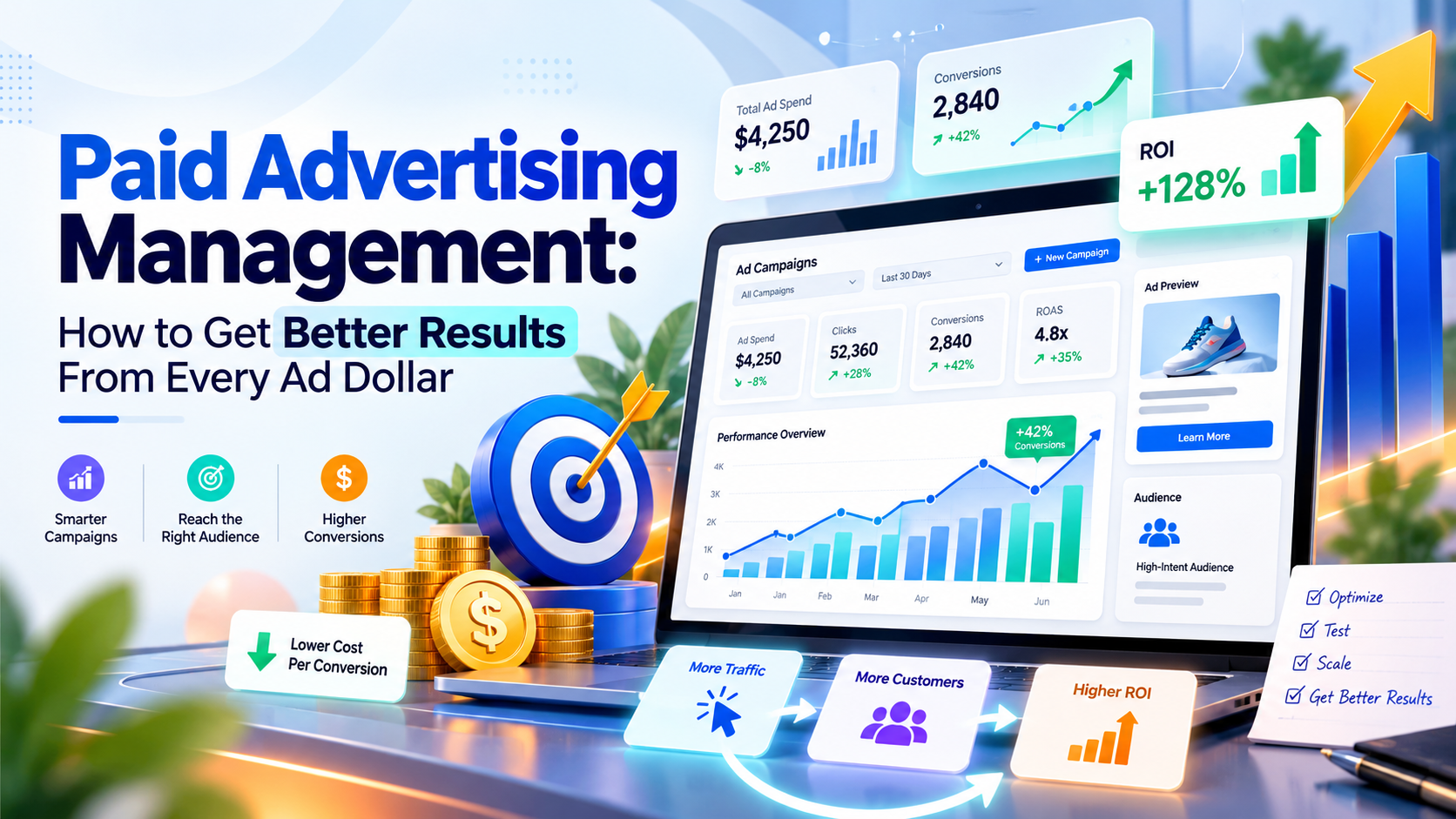
Did you know that nearly 40% of digital marketing budgets are wasted on ineffective campaigns? If you operate a business in the United States, you understand that every cent counts toward your bottom line. Mastering digital advertising management is the most effective way to stop this drain and ensure your capital works harder for you.
This guide serves as your roadmap to a more disciplined process. We will explore how to sharpen your targeting, boost efficiency, and improve your overall return on investment. By refining your paid advertising management approach, you can transform how you connect with your core audience.
Throughout this 12-section framework, we cover everything from setting clear goals to mastering search optimization and landing page design. You will also learn how to track performance, conduct A/B testing, and make informed decisions about your budget. Let’s begin the journey to maximizing your growth.
Key Takeaways
- Identify why nearly half of marketing budgets fail to reach their full potential.
- Learn the core principles of a disciplined approach to campaign oversight.
- Discover how to improve conversion quality through better audience targeting.
- Understand the importance of tracking and testing to optimize your spend.
- Gain a comprehensive 12-step framework for long-term success in the U.S. market.
Stop Wasting Ad Spend
Turn your advertising budget into measurable growth with smarter targeting, disciplined optimization, and data-driven strategies designed to maximize conversions and improve your return on investment.
Set the Business Goals That Should Guide Paid Advertising Management
Your path to profitable growth starts by aligning your advertising strategy with core business realities. Many organizations fall into the trap of chasing vanity metrics like impressions or click-through rates without considering the actual impact on their bottom line. By anchoring your strategy in financial targets, you ensure that every dollar spent contributes to sustainable expansion.
Translate revenue targets into advertising objectives
You must bridge the gap between your annual revenue goals and your daily paid advertising management operations. Start by calculating exactly how much revenue your advertising needs to generate to hit your company targets. Once you have this number, break it down into specific objectives for each channel as part of your paid advertising management strategy.
This process forces you to move beyond generic industry benchmarks. Instead, you create custom targets that reflect your unique cost structure and growth pace. Aligning your ad spend with revenue goals is the foundation of a mature marketing strategy.
Choose the right success metrics for your funnel
Different stages of the customer journey require different ways to measure success. You cannot use the same yardstick for a brand awareness campaign as you would for a direct-response sales effort. Selecting the right metrics ensures your paid advertising management efforts optimize for the right behaviors at every stage.
Separate brand awareness, lead generation, and ecommerce goals
Brand awareness campaigns should focus on reach, frequency, and engagement. In contrast, lead generation efforts require tracking form completions and cost-per-lead. Ecommerce goals demand a laser focus on return on ad spend (ROAS) and conversion value.
Account for gross margin, customer lifetime value, and sales-cycle length
Your acceptable acquisition cost in paid advertising management is not a static number. It must fluctuate based on your gross margins and the long-term value of your customers. If you have a long sales cycle, you must account for the time it takes to convert a prospect into a paying client.
Set budget limits, acceptable acquisition costs, and return thresholds
Before you launch any campaign, define your “stop-loss” points and your profit targets. This discipline prevents paid advertising management teams from overspending on underperforming channels. Effective paid media management requires you to set these boundaries early to protect your margins.
The following table outlines how different business models should approach their primary success metrics and thresholds.
| Goal Type | Primary Metric | Key Financial Factor | Optimization Focus |
|---|---|---|---|
| Brand Awareness | CPM / Reach | Budget Cap | Audience Quality |
| Lead Generation | CPL | Gross Margin | Lead Quality |
| Ecommerce | ROAS | Customer Lifetime Value | Conversion Rate |
By establishing these parameters, you gain the confidence to scale winning campaigns quickly. This structured approach to paid media management ensures that your paid advertising management efforts remain profitable regardless of market fluctuations.
Build a Paid Media Management Structure Around the Customer Journey
You can transform your advertising results through paid advertising management by aligning every campaign with specific stages of the customer lifecycle. A well-organized paid media management strategy ensures that your messaging reaches the right person at the exact moment they are ready to engage. By moving away from isolated ad buys, your paid advertising management creates a cohesive experience that guides prospects toward a final purchase.
Map campaigns to awareness, consideration, conversion, and retention
Your paid advertising management strategy should categorize campaigns based on where the user stands in their decision-making process. Awareness campaigns focus on broad reach, while consideration efforts highlight your unique value proposition. Conversion campaigns target those ready to buy, and retention efforts keep your brand top-of-mind for existing customers.
This structured approach prevents wasted spend on audiences who are not yet ready to convert. It allows you to tailor your creative assets to the specific needs of each group, increasing the likelihood of a positive interaction.
Match search, social, display, video, and retargeting to user intent
Different channels serve different purposes in your digital advertising management plan. Search ads capture high-intent traffic, while social media platforms excel at building brand awareness through visual storytelling. Video content provides a deeper look at your products, and display ads keep your brand visible across the web.
Retargeting acts as the glue that holds these paid advertising management channels together. By matching the channel to the user’s intent, you ensure that your message remains relevant and helpful throughout their journey.
Define the role of first-party data and audience segments
First-party data is your most valuable asset for precise paid advertising management targeting. By leveraging information from your own website and customer lists, you can create highly relevant audience segments. This data allows you to personalize your outreach and improve the efficiency of your ad spend.
Use remarketing without overexposing ads to existing visitors
Remarketing is powerful, but it requires careful frequency management to avoid annoying your audience. You should set strict impression caps as part of your paid advertising management to ensure that your ads remain helpful rather than intrusive. Strategic ad frequency protects your brand reputation while keeping you visible to interested prospects.
Connect paid campaigns with email, CRM, and sales follow-up
Your paid advertising management efforts should never exist in a vacuum. By integrating your ad platforms with your CRM and email systems, you can track the full lifecycle of a lead. This connection allows your sales team to follow up with context, turning clicks into long-term business relationships.
Research Demand and Sharpen Audience Targeting Before You Spend
Effective paid advertising management begins long before you launch your first campaign. By analyzing market demand early through paid advertising management, you can identify the specific problems your customers face and how they search for solutions. This proactive approach ensures that your budget is directed toward high-intent users rather than wasted on irrelevant clicks.
Identify high-value customer problems and search behaviors
To improve paid advertising management, you must understand the pain points that drive your audience to search. Look for patterns in search volume that indicate a user is actively seeking a resolution to a specific issue. When you align your paid advertising management messaging with these behaviors, you create a stronger connection from the very first interaction.
Organize keywords by intent, topic, location, and buying stage
A well-structured account is the backbone of successful paid media management. You should categorize your keywords as part of your paid advertising management based on the user’s journey to ensure the right message reaches them at the right time.
Consider these four pillars for your organization:
- Intent: Distinguish between informational queries and transactional searches.
- Topic: Group keywords by product categories or service offerings.
- Location: Tailor your reach to specific regions where your business thrives.
- Buying Stage: Map keywords to awareness, consideration, or decision phases.
Use customer data to build effective audience groups
Leveraging your existing first-party data allows you to create highly relevant audience segments. By analyzing past customer behavior, you can build profiles that mirror your most profitable clients. TThis data-driven paid advertising management strategy helps you refine your targeting and improve overall campaign efficiency.
Separate exact needs from broad discovery searches
It is vital to distinguish between users who know exactly what they want and those who are just exploring. Use exact match keywords for users with high purchase intent to maximize conversion rates. Conversely, use broader discovery terms to capture interest, but monitor these closely to prevent budget leakage.
Apply geographic, demographic, device, and schedule targeting carefully
Precision is key to effective paid advertising management when managing campaigns in the United States market. You should restrict your ads to specific geographic areas where you can fulfill orders or provide services. Additionally, adjust your bids based on device performance and schedule your ads to appear only when your target audience is most active.
Turn competitor and market research into targeting opportunities
Analyzing your competitors provides a roadmap for effective paid advertising management, showing what works and what to avoid. Look at the keywords they bid on and the messaging they use to attract customers. You can then identify gaps in their strategy to position your brand as the superior choice in your paid media management efforts.
Apply Paid Search Optimization to Campaigns, Ad Groups, and Keywords
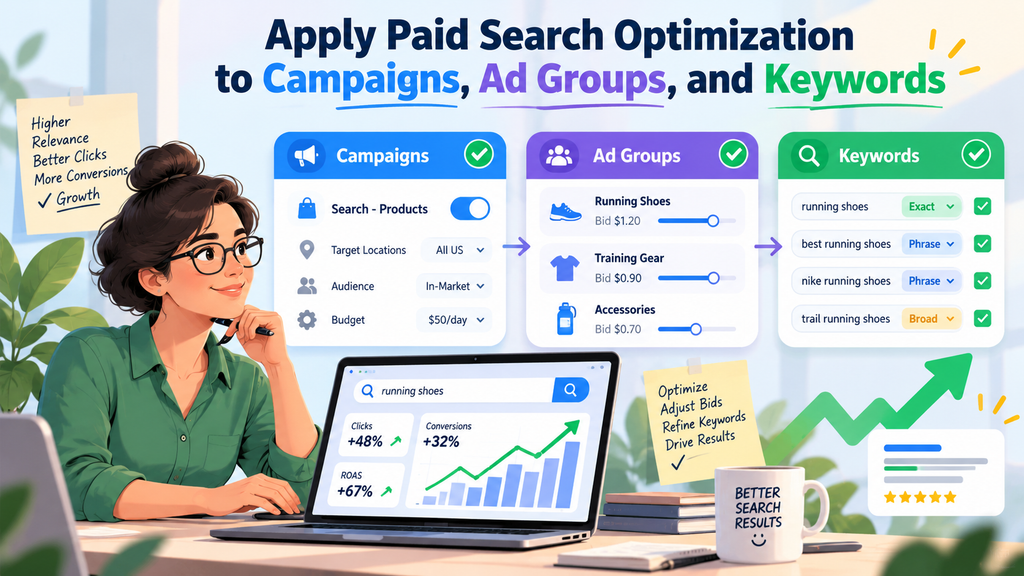
Effective ppc campaign management relies on the synergy between a granular account structure and strategic bidding. By organizing your account with precision through paid advertising management, you ensure that your ads reach the right people at the exact moment they express interest in your solutions.
Build tightly themed campaigns and ad groups
The most successful accounts are built on a foundation of relevance. You should group your keywords into tightly themed ad groups that focus on a single product, service, or user intent. This structure allows you to write highly specific ad copy that resonates with the searcher’s immediate needs.
Use match types and negative keywords to control traffic quality
Controlling your traffic quality is essential to effective paid advertising management and preventing wasted spend. You must leverage match types, broad, phrase, and exact, to balance reach with precision. Furthermore, maintaining a robust list of negative keywords is a critical part of paid search optimization, as it filters out irrelevant queries that do not align with your business goals.
“The secret to successful advertising is not just reaching more people, but reaching the right people with the right message at the right time.”
Write responsive search ads around specific customer benefits
Responsive search ads allow you to test multiple headlines and descriptions as part of your paid advertising management to find the best combination for your audience. Focus your messaging on the specific benefits your customers gain from your product rather than just listing features.
Align headlines and descriptions with the searcher’s intent
Your ad copy must mirror the language your customers use when searching. When your headlines directly address the user’s query, you increase your click-through rate and improve your overall quality score.
Test calls to action, offers, proof points, and differentiators
Continuous testing is the hallmark of high-performing campaigns. You should rotate different calls to action, unique value propositions, and social proof points to see which elements drive the highest conversion rates.
Manage bids according to conversion volume and business value
Professional paid search services are most valuable when they connect keyword-level decisions with broader business outcomes. Instead of bidding solely for clicks, you should adjust your bids based on conversion volume and the actual profit margin of the products or services being advertised. This value-based approach ensures that your budget is always working toward your most profitable goals.
Create Landing Pages That Convert the Click You Paid For
A successful digital advertising management strategy relies heavily on what happens after a user clicks your ad. Even the most precise targeting cannot save a campaign if the destination page creates confusion or unnecessary friction. When users arrive at a page that does not align with their expectations, they leave immediately, wasting your hard-earned budget.
Maintain message match from keyword to landing page
Message match is the foundation of a high-converting landing page and effective paid advertising management. Your headline should mirror the language used in your ad copy to reassure the visitor they are in the right place. This consistency builds confidence and keeps the user focused on the next step.
Make the value proposition clear above the fold
Visitors decide within seconds whether to stay or bounce. You must place your primary value proposition at the very top of the page, visible without any scrolling. Clearly state how your offer solves their specific problem to maintain momentum from the initial click and strengthen your paid advertising management results.
Reduce friction in forms, checkout flows, and scheduling experiences
Every extra field in a form or step in a checkout process acts as a barrier to conversion and can weaken your paid advertising management results. Streamline your user experience by asking only for essential information. A simplified flow ensures that your paid advertising management efforts translate into actual business growth rather than abandoned sessions.
Use trust signals, testimonials, guarantees, and relevant proof
People are naturally cautious when interacting with new brands online. You can overcome this hesitation by integrating social proof directly into your landing page design. Consider the following elements to boost credibility:
- Customer testimonials that highlight specific results.
- Trust badges from industry organizations or security partners.
- Clear, risk-free guarantees that remove the fear of purchase.
- Case studies or data points that prove your effectiveness.
Design mobile-first pages for fast decisions
In the United States, a significant portion of traffic originates from mobile devices. Your pages must load instantly and feature touch-friendly buttons to accommodate users on the go. A mobile-first approach ensures that your digital advertising management remains effective across all screen sizes and connection speeds.
“The goal of a landing page is not just to get a click, but to guide the visitor toward a meaningful action that aligns with your business objectives.”
Run controlled landing-page tests tied to conversion quality
Testing is essential for long-term paid advertising management success, but you must measure the right metrics. Do not focus solely on raw form submissions, as these can often be low-quality leads. Instead, evaluate how your landing page changes impact the actual conversion quality and downstream revenue.
| Test Variable | Primary Goal | Success Metric |
|---|---|---|
| Headline Copy | Improve Relevance | Bounce Rate |
| Form Length | Reduce Friction | Conversion Rate |
| Trust Signals | Build Authority | Lead Quality |
Measure Performance With Reliable Tracking and Attribution
Reliable attribution transforms raw clicks into actionable business intelligence. When you invest in digital channels, paid advertising management requires a clear view of how every dollar influences your bottom line.This level of visibility is the foundation of successful paid advertising management.
insta
Define primary conversions and meaningful secondary actions
Start by identifying the specific events that signal true value for your organization. A primary conversion should represent a completed sale or a qualified lead that directly impacts revenue. These are the metrics that justify your budget and drive your strategy.
Secondary actions, such as newsletter sign-ups or whitepaper downloads, provide context for the user journey. While these do not always result in immediate cash flow, they indicate high intent. Tracking these micro-conversions helps you understand how users engage before they finally commit to a purchase.
Configure Google Analytics 4, ad-platform tags, and offline conversion imports
Modern tracking requires a unified setup across your entire tech stack. You must configure Google Analytics 4 to capture cross-channel behavior while ensuring your ad-platform tags are firing correctly on every key page. This setup ensures that your data remains clean and reliable.
For businesses with long sales cycles, offline conversion imports are vital. By uploading CRM data back into your ad platforms, you can bridge the gap between an initial click and a closed deal. This process is essential for effective paid search optimization.
Use consistent UTM parameters across every campaign
Standardized naming conventions for your URLs prevent data fragmentation. By using consistent UTM parameters, you ensure that every campaign, ad group, and creative asset is tracked accurately in your analytics dashboard. This consistency allows your paid advertising management team to compare performance across different sources without confusion.
Connect lead forms and phone calls to closed-revenue outcomes
Many businesses lose sight of value when a lead moves from a website form to a phone conversation. You should integrate your call tracking software with your CRM to capture the outcome of these interactions. Connecting these touchpoints to actual revenue provides a defensible view of your return on investment.
Distinguish platform-reported conversions from business results
Ad platforms often use modeled data that may inflate your perceived success. It is important to distinguish these platform-reported metrics from your actual business growth. Always verify your ad performance against your internal sales records to ensure your data reflects reality.
| Metric Type | Platform Data | Business Data |
|---|---|---|
| Primary Goal | Click-throughs | Closed Revenue |
| Attribution | Last-click bias | Full-funnel impact |
| Verification | Automated reporting | CRM reconciliation |
Choose an attribution approach that fits your sales cycle
The way you assign credit to your marketing efforts should reflect how your customers actually buy. If your sales cycle is short, a simple last-click model might suffice. However, complex B2B cycles often require data-driven or time-decay models to account for multiple touchpoints.
Selecting the right model ensures that your paid advertising management does not undervalue the top-of-funnel efforts that introduce your brand to new prospects. By aligning your attribution with your unique sales process, you gain the confidence to scale your most effective campaigns.
Optimize PPC Campaign Management Through Structured Testing
You can transform your advertising results through paid advertising management by treating every campaign as an ongoing laboratory for growth. Rather than making reactive account changes based on daily noise, you should adopt a disciplined approach to ppc campaign management. This method ensures that every adjustment you make is backed by evidence rather than intuition.
Improve Your Campaign Performance
Discover where your campaigns lose valuable prospects and unlock better results through precise targeting, optimized landing pages, strategic testing, and smarter paid advertising management.
Prioritize tests by potential impact, confidence, and effort
Not every test is worth your time. Use the ICE framework, Impact, Confidence, and Effort, to rank your experiments. Focus on changes that offer the highest potential for revenue growth while requiring manageable resources.
Test one meaningful variable at a time when possible
To gain clear insights, isolate your variables. If you change your ad copy, your landing page, and your bid strategy simultaneously, you will never know which factor drove the performance shift. Paid search optimization relies on your ability to attribute success to a specific change.
Compare creative, audience, bidding, placement, and landing-page performance
Systematic testing allows you to refine every layer of your funnel. You should regularly evaluate how different elements influence your bottom line:
- Creative: Test headlines, images, and calls-to-action to see what resonates.
- Audience: Compare the conversion rates of different demographic or interest-based segments.
- Bidding: Experiment with automated versus manual strategies to find your efficiency sweet spot.
- Landing Pages: Use A/B testing to ensure your destination page matches the user’s intent.
Use statistically useful time windows instead of reacting to daily changes
Avoid the trap of checking your dashboard every hour. Data needs time to accumulate before it becomes statistically significant. Allow your tests to run for at least two weeks to account for weekly buying cycles and avoid making premature decisions based on small sample sizes.
Document hypotheses, test conditions, and decisions
Maintain a central log of your experiments. Record your initial hypothesis, the specific changes you implemented, and the final outcome. This documentation prevents you from repeating past mistakes and helps you build a library of winning tactics.
Scale winning campaigns without sacrificing efficiency
Once a test yields a clear winner, you must scale it carefully. Increase your budget in small, controlled increments to ensure that your return on ad spend remains stable. By scaling only what is proven to work, you protect your budget while driving consistent, measurable growth.
Control Budget Allocation, Bidding, and Ad-Frequency Waste
You can transform your advertising results by shifting your focus from vanity metrics to true profitability. Effective paid media management requires you to prioritize outcomes that directly impact your bottom line rather than chasing high impression counts.
Move budget toward campaigns that produce profitable outcomes
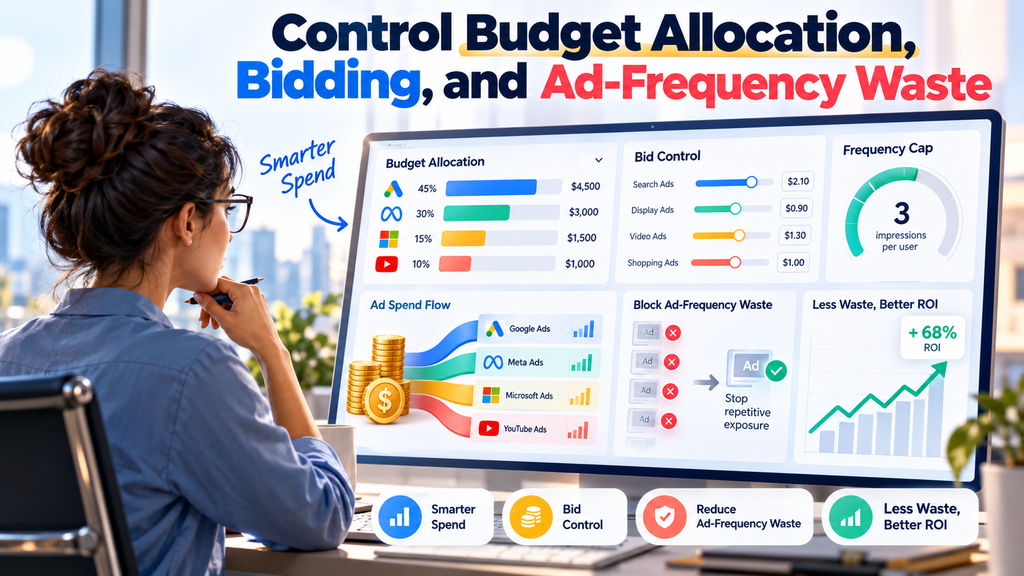
Successful campaigns often hide in plain sight, while underperforming ones drain your resources. You should regularly audit your account to identify which segments drive the highest return on investment. By reallocating funds from low-performing ad groups to those with proven conversion paths, you maximize the efficiency of every dollar spent.
Set rules for pausing, reducing, or increasing spend
Automation is a powerful tool, but it works best when guided by clear, predefined rules. Establish specific thresholds for when to pause a campaign that fails to meet your minimum conversion requirements. Conversely, set aggressive scaling rules for campaigns that consistently hit your target acquisition costs to ensure you capture all available demand.
“The goal of marketing is to know and understand the customer so well the product or service fits him and sells itself.”
Balance automated bidding with human oversight
While machine learning algorithms are excellent at processing data, they lack the strategic context that only you can provide. You must maintain paid advertising management oversight to ensure that automated systems align with your broader business goals. Human intervention is necessary to adjust for seasonal trends, supply chain issues, or sudden shifts in market competition.
Know when target CPA, target ROAS, or manual bidding makes sense
Choosing the right bidding strategy depends on your specific goals and the maturity of your account data. Use target CPA when you have a stable conversion history and want to focus on acquiring customers at a fixed cost. Opt for target ROAS if your primary objective is revenue growth, or stick to manual bidding when you need granular control over high-value keywords during a product launch.
Protect budgets from low-intent placements and accidental broad targeting
Unchecked algorithms often waste money on irrelevant traffic sources. You must actively exclude low-intent placements and monitor search query reports to prevent accidental broad targeting. This proactive approach to ppc campaign management ensures your budget is reserved for users who are genuinely ready to engage with your brand.
Manage frequency, overlap, and diminishing returns across channels
Over-exposure can lead to ad fatigue, which hurts your brand perception and wastes your budget. Monitor your frequency caps across all platforms to ensure you are not bombarding the same audience repeatedly. Furthermore, analyze your cross-channel data to identify audience overlap, which helps you avoid bidding against yourself and allows you to scale your ppc campaign management efforts without hitting the wall of diminishing returns.
Use Reporting to Turn Campaign Data Into Better Decisions
Effective digital advertising management relies on your ability to turn raw numbers into actionable business strategies. When you move beyond simple platform statistics, you gain a clearer view of how your marketing spend impacts your bottom line. This shift ensures that every dollar you invest is tied directly to your growth objectives.
Build a reporting dashboard around business outcomes
Your reporting dashboard should prioritize the metrics that matter most to your company. Instead of focusing on vanity metrics like total impressions, highlight KPIs that reflect actual revenue and customer acquisition. This approach keeps your team aligned with the goals that drive real business value.
Review spend, impressions, clicks, conversion rate, CPA, and ROAS together
You must analyze your data holistically to understand the health of your campaigns. Reviewing spend, impressions, clicks, conversion rate, CPA, and ROAS in a single view reveals the true efficiency of your efforts. Seeing these metrics together allows you to identify where you are overspending and where you have room to scale.
Diagnose performance changes with segmented analysis
When performance shifts, you need to dig deeper to find the root cause. Segmented analysis helps you isolate variables and understand exactly what is driving your results. This granular view is essential for effective paid advertising management.
Compare brand and nonbrand traffic separately
Always separate your brand and nonbrand traffic to get an accurate picture of performance. Brand campaigns often show high conversion rates that can mask poor performance in your nonbrand acquisition efforts. By splitting these, you can optimize your nonbrand keywords without being misled by your branded search volume.
Break down results by device, location, audience, creative, and query
Drilling down into specific segments helps you refine your targeting and messaging. Check if your ads perform better on mobile devices or in specific geographic regions. Furthermore, reviewing performance by audience segment and creative asset ensures that you are delivering the right message to the right person at the right time.
Set a weekly optimization rhythm and a monthly strategic review
Consistency is the key to long-term success in your advertising efforts. Establish a weekly rhythm to handle tactical adjustments, such as bid changes or pausing underperforming keywords. Complement this with a monthly strategic review to evaluate your progress toward high-level business goals and adjust your long-term roadmap accordingly.
Decide When to Hire a Paid Advertising Manager or Paid Search Agency
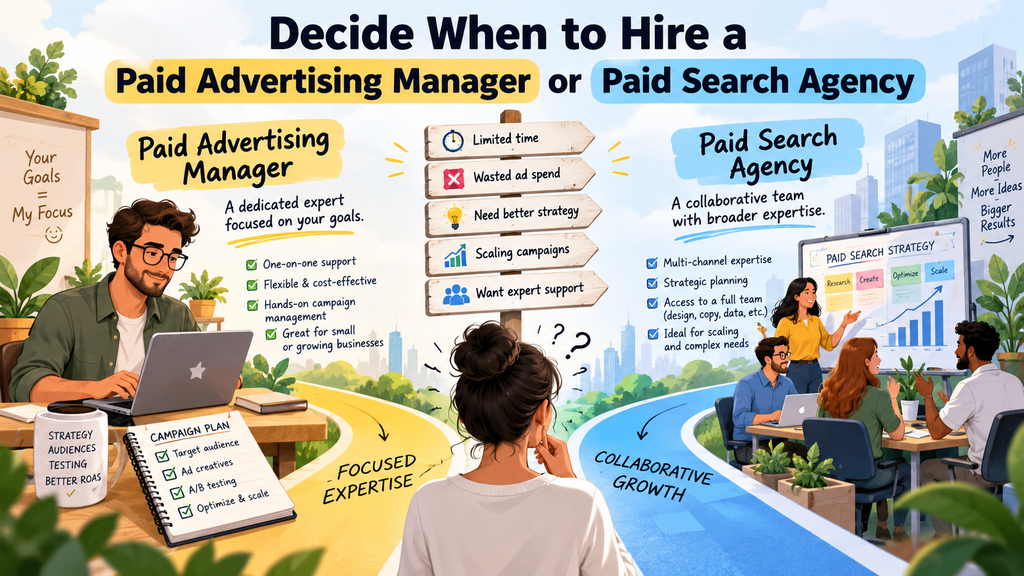
Deciding whether to manage your paid media in-house or outsource to an agency is a pivotal moment for your growth. As your business scales, the complexity of managing multiple channels often outgrows the capacity of a generalist team. You must determine if you need a dedicated paid advertising manager or if a broader paid media management partner is the right fit for your goals.
Identify the workload and expertise your internal team lacks
Start by auditing your current team’s bandwidth and technical skill set. If your staff spends more time troubleshooting tracking errors than optimizing bids, you are likely missing out on growth opportunities. A lack of specialized knowledge in platform-specific algorithms can lead to wasted spend and poor conversion rates.
“The secret to successful advertising is not just spending more, but spending smarter by aligning your resources with the right expertise at the right time.”
Compare paid search services, digital advertising management, and full paid media management
Not all providers offer the same level of support. Some firms focus strictly on paid search services, which are ideal if your primary goal is capturing high-intent traffic on Google. However, if you need a holistic approach across social, display, and video, you should look for a partner capable of full-funnel strategy.
| Service Level | Primary Focus | Best For |
|---|---|---|
| Specialized Search | Google/Bing Ads | Lead Gen & E-commerce |
| Full Media Management | Cross-Channel Strategy | Brand Growth & Scaling |
| Consulting Only | Strategy & Audits | Internal Team Coaching |
Evaluate an agency’s strategy, tracking process, and reporting standards
A reliable partner should demonstrate a clear methodology for how they plan to achieve your business objectives. Ask for case studies that mirror your industry and specific sales cycle. Their reporting should focus on business outcomes rather than just vanity metrics like clicks or impressions.
Ask how the provider handles testing, budget changes, and account ownership
Transparency is non-negotiable when it comes to your data. Ensure the agency allows you to retain ownership of your ad accounts so you are never locked out of your own historical data. Furthermore, ask how they prioritize A/B testing and how quickly they can pivot budgets when market conditions shift.
Review pricing models, including affordable PPC management options
Pricing structures vary from flat monthly fees to percentage-of-spend models. While you may look for affordable PPC management, remember that the cheapest option often lacks the deep analytical support required for long-term success. Focus on the potential return on investment rather than just the lowest monthly retainer.
Set clear responsibilities, access requirements, and performance expectations
Once you select a partner, define the relationship clearly from day one. Establish exactly who has access to your CRM and analytics platforms to ensure data security. Finally, set recurring performance reviews to ensure the agency remains aligned with your evolving business targets.
Maximize Every Advertising Dollar
Ready to scale profitably? Strengthen your paid media strategy, reduce wasted spend, and turn high-intent traffic into customers with a performance-focused advertising approach.
Conclusion
Mastering your digital presence requires a shift from simple spending to strategic investment. Effective paid advertising management connects your business goals directly to the customer journey through precise targeting and persuasive messaging.
You gain control over your results by aligning every ad dollar with measurable revenue outcomes. This process relies on disciplined budget allocation, controlled frequency, and rigorous testing of your creative assets. When you prioritize data-driven decisions over vanity metrics, you create a foundation for long-term growth in the United States market.
Your success depends on the right mix of internal expertise and external support. Whether you manage campaigns in-house or partner with a specialized firm, your paid media management must remain focused on your unique sales cycle and growth objectives. Use these insights to build a system that turns every click into a valuable customer relationship.
Review your current performance metrics today to identify your next optimization opportunity. Consistent refinement of your strategy ensures your brand stays competitive and profitable in an evolving digital landscape.
FAQs
What is the primary benefit of investing in professional paid advertising management?
The core advantage is shifting from a reactive approach to a disciplined, revenue-focused strategy. Professional paid advertising management ensures that your targeting, efficiency, and conversion quality are continuously optimized, allowing you to maximize the return on investment (ROI) from every dollar spent rather than chasing vanity metrics like impressions or clicks.
How does paid search optimization improve my campaign’s traffic quality?
Effective paid search optimization involves building tightly themed campaigns and ad groups while utilizing precise match types and negative keyword lists. By filtering out irrelevant searches and aligning your Responsive Search Ads with specific searcher intent, you ensure that your budget is reserved for high-value prospects most likely to convert.
Why should I prioritize business outcomes over platform-reported metrics in my digital advertising management?
Platform-reported data can often be misleading due to attribution nuances. True digital advertising management connects ad spend directly to your CRM and closed-revenue outcomes. By focusing on Customer Lifetime Value (LTV) and acceptable acquisition costs, you can make scaling decisions based on actual profit rather than just the number of leads generated in a dashboard.
What is the difference between specialized paid search services and comprehensive paid media management?
Paid search services typically focus on intent-based platforms like Google Ads or Microsoft Advertising. In contrast, paid media management takes a holistic view of the customer journey, coordinating search, social, display, and video ads to ensure a consistent message from the initial awareness stage through to final retention and remarketing.
How can I identify if I need a dedicated paid advertising manager or an external paid search agency?
This decision depends on your internal team’s workload and specific expertise. You should consider a paid advertising manager if you require deep, daily integration with your sales team. However, a paid search agency often provides broader access to specialized tools, platform betas, and a diverse range of experience across multiple United States market verticals.
What role does structured testing play in ppc campaign management?
Disciplined ppc campaign management treats every ad as an experiment. By using a framework that prioritizes tests based on impact, confidence, and effort, you can systematically improve creative elements, landing page performance, and bidding strategies. This prevents reactive changes and ensures that your account scales based on statistically significant data.
Is it possible to find affordable PPC management that still delivers high-quality results?
Yes, affordable ppc management is achievable when the provider focuses on efficiency and eliminating waste. The key is to ensure that “affordable” does not mean cutting corners on tracking setups or strategic oversight. A high-quality provider will offer transparent pricing while maintaining a rigorous focus on your specific business benchmarks and growth objectives.
How should I evaluate the reporting standards of a potential advertising partner?
You should look for reporting that goes beyond basic data to provide actionable insights. A professional partner should offer segmented analysis, breaking down results by device, location, and audience, and maintain a weekly optimization rhythm. Ensure they provide a clear view of how spend, CPA, and ROAS are trending in relation to your primary business goals.