
Have you ever spent hours creating a website, publishing helpful content, and improving your pages, only to find that hardly anyone visits? You are not alone. Getting people to a website is one of the biggest challenges for bloggers, online stores, affiliate marketers, service providers, and businesses trying to grow online. For many website owners, understanding where to buy website traffic is an important first step toward reaching more visitors.
That is why so many website owners search for where to buy website traffic when organic visitors are slow to arrive or a campaign needs a boost. Buying traffic can help you bring visitors to your pages, test landing pages, introduce an offer to a new audience, and learn how people respond to your website.
But there is a catch: not every traffic source delivers the same quality, and more visitors do not automatically mean more customers. Knowing where to buy website traffic also means understanding the source and purpose of the visits you receive.
The real question is not simply where to buy website traffic. It is how to choose a provider that fits your goals, explains what you are paying for, and gives you enough information to evaluate the results.
In this guide, we will walk through seven practical checks to make before spending your budget and help you understand where to buy website traffic for your goals. We will also explain the difference between traffic types, how to assess visitor quality, what to watch for in reporting, and how DSPTraffic may fit into your research.
Key Takeaways
- Define your goal first. Choose traffic based on whether you want to test a landing page, attract potential customers, or increase relevant visits.
- Understand the traffic source. Ask how visitors are acquired and what targeting options are available.
- Do not choose on price alone. Cheap website traffic is only useful when it serves a clear purpose and its limitations are understood.
- Measure meaningful results. Look beyond visitor counts to engagement, conversions, and the cost of achieving your goal.
- Start with a controlled test. Set a budget, use tracking, and evaluate the results before increasing your spend.
Ready to Bring More Visitors to Your Website?
Turn your website into a traffic destination with the right strategy. Explore traffic options, reach new audiences, and start testing what works.
What Does It Mean to Buy Website Traffic?
Buying website traffic means paying for a service or advertising campaign intended to send visitors to a website. Instead of relying entirely on search engines, social media posts, referrals, or word of mouth, you invest money to bring people to a specific page. Researching where to buy website traffic can help you compare the available ways to attract those visitors.
If you are researching where to buy website traffic, you will generally encounter several types of providers. These may include advertising networks, search and social advertising platforms, native advertising services, and dedicated website traffic providers. Each option may suit a different need, so consider your objectives when deciding where to buy website traffic.
The key difference is how they source visitors, how much control you have over targeting, and what information they provide about delivery.
For example, a paid search campaign can show ads to people searching for specific terms. A social campaign can reach audiences based on the platform’s available targeting options. A dedicated traffic service may offer campaign settings related to traffic volume, source, or audience, depending on its actual product features.
These options are not interchangeable. A campaign designed to test whether a landing page loads properly has different requirements from one intended to generate purchases.
Why Do People Buy Website Traffic?
There are several legitimate reasons to pay for visits.
- Testing a website: Check page speed, forms, navigation, and landing-page performance under real visits.
- Promoting a new page: Bring attention to a new product, article, service, or offer.
- Supporting a marketing campaign: Add a paid channel while organic marketing develops.
- Learning about visitors: Evaluate how people interact with a page and whether the message is clear.
- Testing conversion ideas: Compare headlines, page layouts, or calls to action using a controlled experiment.
Buying traffic is not a shortcut to guaranteed rankings, sales, or profitability. Search visibility depends on many factors, and visitors may leave without taking action. Treat paid traffic as a marketing input to measure, not a promise of business growth, when evaluating where to buy website traffic.
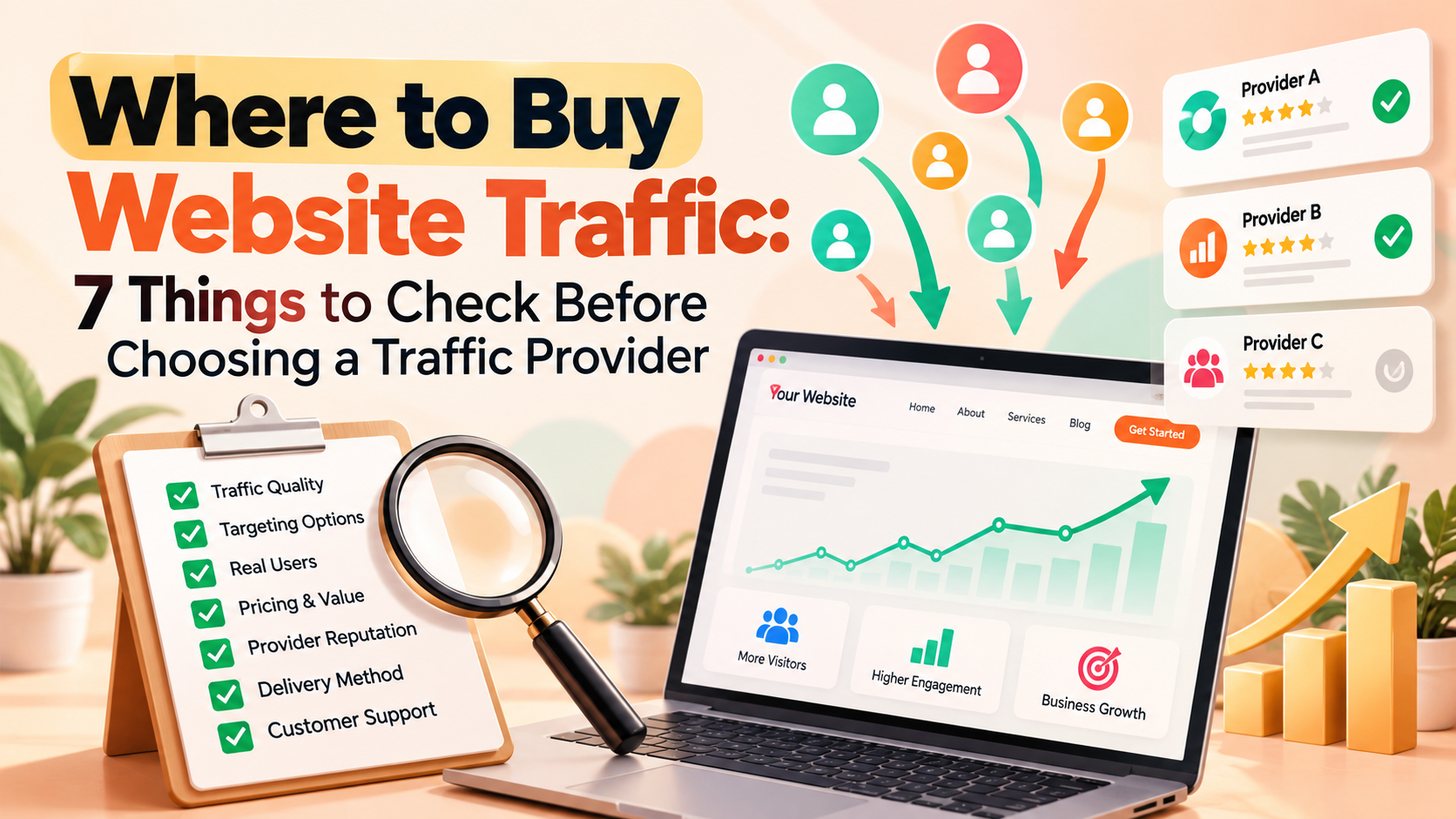
Where to Buy Website Traffic: 7 Things to Check Before Choosing a Traffic Provider
When comparing providers, it is tempting to focus on the headline price or the number of visits promised. However, the better approach is to examine what you will receive, how it will be delivered, and how you will know whether it was useful.
Here are seven checks to help you make a more informed choice about where to buy website traffic.
1. Understand Where the Traffic Comes From
The first question to ask any provider is simple: How do you acquire the visitors you send to my website?
A provider should be able to explain its traffic sources in understandable terms. This information is essential when comparing where to buy website traffic for a specific audience. Depending on the service, visitors may come through advertising placements, publisher networks, referrals, or other acquisition methods. The available sources vary, so do not assume every provider offers the same options.
Knowing the source helps you decide whether the traffic matches your audience and campaign goals. Imagine that you run a store selling specialist gardening equipment. A large number of visits from people with no interest in gardening may increase your analytics count but contribute little to your business.
A smaller campaign that reaches a more relevant audience could give you more useful information. That is why the traffic source matters when deciding where to buy website traffic.
Before choosing where to buy website traffic, ask:
- What sources can deliver the visits?
- Can I choose or restrict traffic sources?
- Is the traffic generated through advertising placements or another method?
- Can the provider explain how visitors are directed to my page?
- Are any traffic types excluded from the campaign?
Be cautious if a provider cannot explain its acquisition methods or makes sweeping promises about visitor quality without explaining how that quality is assessed.
Why Traffic Source Matters
The source influences what visitors might be interested in, how they arrive, and what you can reasonably expect them to do. Someone who deliberately clicks a relevant advertisement may behave differently from someone who encounters a page through another type of placement.
Neither a source label nor a large visitor count proves that a campaign is effective. You need to compare source information with what happens after people land on your website before deciding where to buy website traffic again.
2. Check the Available Targeting Options
The second check is whether the provider can help you reach the audience you actually want. This should be a priority when researching where to buy website traffic for a particular market.
When people search for where to buy website traffic, they often mean more than simply finding a service that can deliver visits. They want visits that make sense for their website, location, content, or offer.
Depending on the platform, targeting options may include geography, device, traffic source, campaign settings, or audience characteristics. Not every provider offers all of these options, and the meaning of each setting can differ.
For example, a local service business may care most about visitors from the areas it serves. A mobile application landing page may need visits from compatible devices. An international blog may be interested in testing different geographic markets. Consider these needs before choosing where to buy website traffic for your website.
Before paying, confirm which settings are genuinely available and whether they apply to your selected campaign.
How to Choose Targeting That Fits Your Website
Start with three questions:
- Who is the intended visitor? Describe the person who could benefit from your content or offer.
- Where should that person be located? Choose only locations that make sense for your business or test.
- What should the visitor be able to do? Decide whether you want to test a page, read an article, view a product, or complete a measurable action.
If you are wondering where to buy the best targeted website traffic, look for a provider whose actual targeting controls match these needs. Do not rely only on terms such as “targeted,” “premium,” or “high quality.” Ask what those terms mean in practice.
Targeting can improve the relevance of a campaign, but it cannot guarantee that every visitor will be interested, remain on the page, or make a purchase. Keep this limitation in mind when comparing where to buy website traffic providers.
3. Compare Pricing Without Ignoring Traffic Quality
Budget is important, especially if you are a small business or a new website owner. However, the lowest price is not automatically the best deal. Price should be one of several factors you consider when deciding where to buy website traffic.
When comparing cheap website traffic offers, examine the delivery terms, traffic source, targeting options, reporting, and any restrictions. A low cost per visit can look attractive until you discover that the visits do not help you answer your marketing question.
Likewise, a more expensive campaign is not necessarily better. Its value depends on your goals, the quality of the traffic, and the results you can measure.
Understand the Cost Per Visitor
A basic way to compare campaigns is to calculate the cost per visit:
Cost per visit = Total campaign cost ÷ Number of visits delivered
For example, if you spend $100 and receive 2,000 visits, the cost per visit is $0.05. If another campaign costs $80 and delivers 1,000 visits, the cost per visit is $0.08.
The first campaign has the lower cost per visit. That does not automatically make it more effective. If the second campaign produces more relevant engagement or useful conversions, it may provide greater value for your particular goal. This comparison can help you make a more informed decision about where to buy website traffic.
You should also distinguish between a delivered visit and a meaningful business result. A visit is not the same as a lead, a sale, a newsletter signup, or a qualified customer.
Questions to Ask About Pricing
Before deciding where to buy website traffic, confirm:
- What is included in the quoted price?
- Is there a minimum order or campaign budget?
- Can I run a small test before making a larger commitment?
- Are there extra charges or restrictions?
- What happens if the delivery does not match the agreed terms?
- Are reporting and tracking tools included, or must I configure them separately?
Read the offer carefully before paying. If a promise sounds unusually good, ask for clear terms and evidence rather than assuming the claim is accurate. Use the same checks for every provider you consider when researching where to buy website traffic.
4. Evaluate Traffic Quality and Set Realistic Expectations
A provider may deliver the number of visits you ordered, but that alone does not tell you whether the traffic is useful.
Traffic quality depends on your campaign purpose. Your campaign purpose should guide where to buy website traffic and how you measure its value. For a technical test, you may mainly need visits that allow you to check page loading, form behaviour, and analytics setup. For a commercial campaign, you may care more about relevant audiences, meaningful engagement, qualified leads, or sales.
This is why you should define quality before deciding where to buy website traffic.
What Can You Measure?
Use analytics and conversion tracking to examine indicators such as:
- Engaged sessions: Whether visits meet the engagement criteria used by your analytics platform.
- Engagement time: How long people actively engage with your site, where this measurement is available.
- Pages viewed: Whether visitors explore additional content or products.
- Conversion rate: The percentage of visits or users that complete a defined action, using a consistent calculation.
- Cost per conversion: How much you spend to obtain each tracked action.
- Lead or sale quality: Whether the resulting enquiries or purchases are relevant to your business.
No single metric tells the whole story when assessing where to buy website traffic and whether the campaign is useful. A short visit could be a poor experience, but it could also mean someone quickly found the information they needed. A longer visit is not necessarily valuable if the visitor never takes a relevant action.
Compare several indicators and interpret them in the context of your website.
Watch for Warning Signs
Be careful with providers that guarantee sales, search rankings, or a specific return on investment simply because they deliver a certain number of visits. Those outcomes depend on factors beyond traffic delivery, including the offer, website experience, audience fit, pricing, and competition.
Also investigate unexplained traffic spikes, repetitive behaviour, suspicious referral patterns, and visits that do not align with the agreed campaign settings.
When evaluating where to buy website traffic, ask how the provider describes and monitors its traffic, what reporting is available, and what remedies apply if delivery does not meet the stated terms. These questions are important whenever you evaluate where to buy website traffic.
Turn More Clicks Into Meaningful Opportunities
Explore DSPTraffic’s available traffic packages, review targeting options, and find a solution that fits your goals. Start small, track results, and grow smarter.
5. Look for Transparent Reporting and Tracking Support
A traffic campaign should not leave you guessing about what happened to your budget. Reporting helps you compare the agreed delivery with the activity recorded on your website. Review reporting features before deciding where to buy website traffic for a measurable campaign.
Before you select a provider, find out what campaign information you will receive. Depending on the service, this may include delivered visit counts, campaign status, source information, targeting settings, or other performance data. Confirm the exact reporting features instead of assuming they are included.
Set Up Tracking Before Your Campaign Starts
If you want to understand the results when deciding where to buy website traffic, configure your analytics before sending paid visitors to the page.
A practical setup includes:
- Confirm that your analytics tool records visits correctly.
- Use consistent campaign names and tracking parameters, such as UTM tags, where appropriate.
- Define important actions, such as a form submission, signup, or purchase.
- Test that the events or conversions are recorded correctly.
- Record the campaign budget, start date, destination URL, and expected delivery.
- Review the results after the campaign and compare them with your original objective.
UTM parameters can help identify traffic associated with a campaign in compatible analytics setups. They do not independently prove that visitors are genuine or interested, and they need to be configured consistently.
Why Reporting Matters
Suppose a campaign sends visitors to a product page, but your analytics records very few visits from the expected campaign source. That difference is worth investigating. Possible explanations include tracking configuration, redirects, consent settings, reporting delays, or differences in how the provider and analytics platform count visits.
Do not immediately conclude that the provider has failed—or that the campaign succeeded. Compare the available records, investigate discrepancies, and ask the provider for clarification.
Transparent reporting makes it easier to decide whether you should repeat a campaign, change the targeting, improve your page, or stop spending. Reliable reporting should be part of your evaluation when comparing where to buy website traffic.
6. Check Delivery Terms, Support, and Website Safety
The sixth check is about the practical details that are easy to overlook when you are focused on traffic numbers.
Before you buy traffic to your website, review the provider’s delivery process, expected timeline, support options, and policies. You should understand what happens after payment and how you can get help if something does not work as expected. Check these details before choosing where to buy website traffic from a new provider.
Confirm the Campaign Details
Check the following before placing an order:
- Destination URL: Make sure the campaign points to the correct, working page.
- Delivery schedule: Confirm whether visits are expected gradually or over a defined period.
- Volume and pacing: Understand the agreed amount and how it is expected to be delivered.
- Targeting settings: Confirm that the selected settings are reflected in the order.
- Support channels: Find out how to contact the provider if delivery or configuration raises questions.
- Refund and dispute terms: Read the actual policy and any conditions that apply.
- Restrictions: Check whether your website, offer, or destination page must meet specific requirements.
A clear order description can prevent misunderstandings. Keep a copy of the order details so you can compare the final delivery with what you purchased.
Protect Your Website and Reputation
Your website should be secure and ready to receive visitors. Use HTTPS, keep your content management system and plugins updated, and make sure forms and checkout pages work correctly. Avoid giving a traffic provider unnecessary access to your website, analytics account, or advertising accounts.
Also review whether the proposed traffic methods comply with the policies of any advertising networks, analytics services, affiliate programmes, and other platforms you use. Artificial or incentivized visits can be restricted or unsuitable for certain purposes. Do not assume that traffic can safely be used to inflate ad impressions, manipulate rankings, or generate fake engagement.
If your goal is to earn advertising revenue, comply with the relevant advertising programme’s traffic policies. Paid visits should never be treated as a way to manufacture invalid ad clicks or impressions.
A responsible provider relationship begins with clear terms, limited access, and a legitimate campaign purpose. These precautions matter regardless of where to buy website traffic for your campaign.
7. Choose a Provider That Fits Your Goal and Test Before Scaling
The final check is the simplest: choose a provider based on the job you need it to do, not just on a headline promise.
A campaign for a new blog post may have a different objective from a campaign for a product launch. Similarly, a website owner testing analytics does not necessarily need the same targeting options as an online store seeking qualified buyers. Clarifying this difference helps you determine where to buy website traffic that suits your needs.
When comparing where to buy website traffic, use a short evaluation checklist:
| What to check | What a good answer should clarify |
|---|---|
| Traffic source | How visitors are acquired and what source information is available |
| Targeting | Which campaign settings you can actually select |
| Pricing | What the quoted cost includes and any minimums or restrictions |
| Delivery | Expected volume, timing, and how delivery is reported |
| Measurement | What data is available and how you can track outcomes |
| Support | How to ask questions or resolve delivery issues |
| Terms | Applicable refund, usage, and traffic policies |
You do not need a perfect answer to every question before beginning, but you should understand the important limitations and risks.
Run a Small, Measurable Test
Instead of committing your entire budget immediately, consider starting with a controlled test if the provider and campaign offer allow it.
Choose one landing page, one main objective, and a budget you can afford to lose if the experiment does not produce useful results. Check your analytics configuration before launch and record a baseline for comparison.
After the campaign, ask:
- Was the agreed traffic delivered?
- Did the visitors match the intended source and targeting settings as far as the available data shows?
- Did analytics record the visits consistently?
- Did the campaign produce useful engagement or conversions?
- What did I learn that could improve the next test?
If the campaign meets your objective, you can consider a cautious increase. If the results are weak, identify whether the problem lies with the traffic source, audience, landing page, offer, or tracking setup before spending more. Use these findings to refine your next decision about where to buy website traffic.
This approach makes your decision about where to buy website traffic a measured business choice rather than a guess.
Where Does DSPTraffic Fit When You Want to Buy Website Traffic?
After reviewing the seven checks, you may want to compare an actual provider against your requirements. DSPTraffic is one option to investigate if you are looking for a dedicated website traffic service rather than setting up every campaign through a traditional advertising platform yourself.
According to its website, DSPTraffic offers website traffic packages with device and geographic targeting options. Its homepage describes a service that allows customers to choose a package, select device and location preferences, complete payment, and monitor visits through analytics. The site also describes a network involving websites, social media pages, and other online platforms as traffic sources. .
These details make DSPTraffic relevant to website owners who want to compare dedicated traffic services. However, the right choice still depends on your campaign goal, budget, destination page, and the type of visitors you need.
What Can You Check Before Ordering From DSPTraffic?
Rather than making a decision based on promotional language alone, review the service against the same criteria you would use for any provider.
1. Device targeting
DSPTraffic describes options for mobile, desktop, and mixed-device traffic. This may be useful if you want to examine how a page performs on different devices. For instance, an online store could review its mobile product page separately from its desktop experience.
Before ordering, confirm the device settings available for your chosen package and consider whether your website is ready for those visitors.
2. Geographic targeting
DSPTraffic lists location-based options, including different country and regional groupings. If your business serves a specific market, check the available locations and confirm that the option you select aligns with your audience.
Remember that selecting a country does not guarantee every visitor will be interested in your product. Geographic relevance is one part of traffic quality, not a substitute for understanding visitor intent.
3. Analytics and measurement
DSPTraffic says its service can be monitored through Google Analytics and describes tracking information such as visits, bounce rate, session duration, and engagement. Before a campaign starts, verify that your own analytics setup works and that you know which measurements matter for your goal.
Do not assume that a traffic increase automatically proves better rankings, higher sales, or stronger customer engagement. Evaluate the results using your own data and business objectives.
4. Delivery expectations
The DSPTraffic website describes traffic delivery beginning within one hour of order confirmation. Because delivery timing can depend on the selected package and its terms, confirm the current expectation for your specific order before paying.
5. Trial availability and terms
DSPTraffic mentions a free trial for qualifying websites and advises prospective customers to contact support about current offers. Trial eligibility may depend on the website and applicable conditions, so check before planning your budget around it.
Its website also states that sales are final and refunds are not offered for its digital traffic services. That is an important consideration: read the current terms carefully and make sure you understand them before placing an order. .
Who Might Consider DSPTraffic?
A dedicated traffic provider such as DSPTraffic may be worth researching if you want to:
- Increase the number of visits to selected website pages.
- Test a landing page or review how a page behaves with additional visits.
- Compare traffic packages with device or geographic preferences.
- Monitor campaign activity through your analytics setup.
- Explore a paid traffic option alongside your existing marketing activities.
However, a service designed to deliver visits is not necessarily the best option for every objective. If you need people actively searching for a particular product, a search advertising campaign may offer a more direct way to connect your ads with that intent. If your primary goal is building a loyal audience over time, useful content, email marketing, search engine optimization, and community building may be essential parts of your strategy.
When researching where to buy website traffic, compare the service’s real capabilities with what you need. Ask questions, check the terms, and make your choice based on evidence rather than expectations.
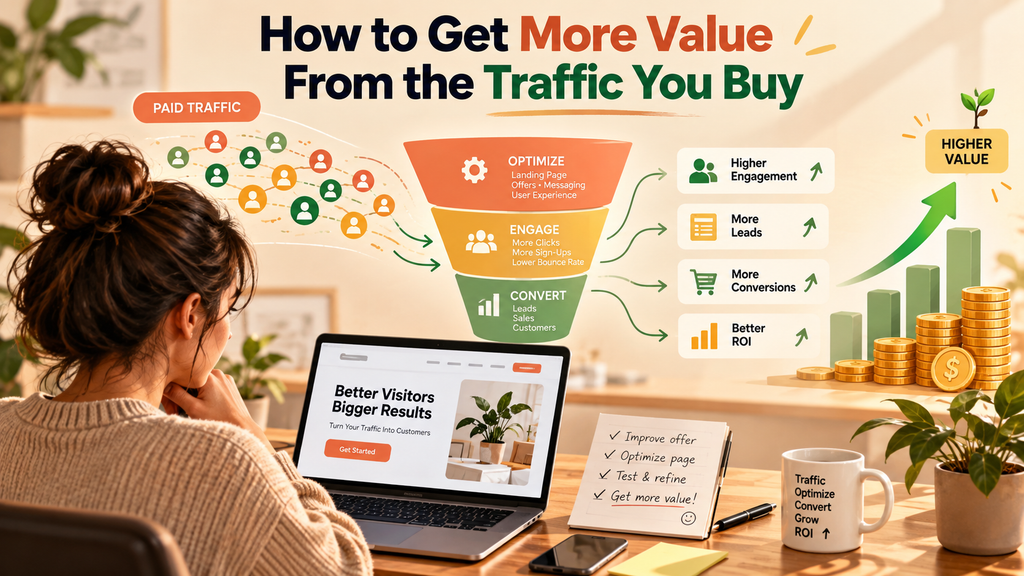
How to Get More Value From the Traffic You Buy
Finding a provider is only one part of the process. Your website also needs to give visitors a reason to stay, explore, or take the next step.
Improve Your Landing Page Before Launch
Imagine paying for 1,000 visits to a page that takes too long to load, has a confusing headline, or makes it difficult to find the main offer. Even relevant visitors may leave because the experience is frustrating.
Before you buy traffic to your website, check that:
- Your page loads properly on mobile and desktop.
- The headline clearly explains what the page offers.
- The content answers the visitor’s main question.
- The call to action is easy to find.
- Forms, checkout steps, and important links work.
- Your privacy notice and other necessary disclosures are available.
These improvements cannot guarantee conversions, but they remove avoidable problems that can waste a campaign budget.
Match the Destination Page to the Campaign
Do not send every campaign to your homepage by default. If you are promoting a specific product, use the relevant product page when the provider’s rules and campaign setup allow it. If you want people to read a particular guide, direct them to that article.
A relevant destination helps visitors understand what to do next. It also makes campaign measurement more meaningful because you can evaluate the performance of the page associated with the campaign.
Use a Clear Testing Plan
Write down what you want to learn before the campaign begins. For example:
- Can visitors find the information on this page?
- Does the form work correctly?
- Which headline produces more signups in a properly controlled test?
- Are visitors from the intended market engaging with the offer?
- Does the cost per qualified lead fit the business budget?
Avoid changing too many things at once. If you change the traffic source, landing-page design, offer, and targeting simultaneously, it becomes harder to understand which change influenced the outcome.
Do Not Confuse More Traffic With Better SEO
Paid visits can help you test content and observe website behaviour, but they should not be treated as a guaranteed way to improve search rankings. Search visibility depends on many factors, including the usefulness and relevance of your content, technical accessibility, and how search engines evaluate your pages.
Likewise, a traffic provider’s labels do not determine how Google or another analytics platform classifies each visit. Review your traffic reports and investigate unusual source classifications rather than assuming that purchased visits will count as organic search traffic.
For sustainable growth, combine suitable paid campaigns with useful content, a strong user experience, technical SEO, and marketing channels that fit your audience.
Give Your Website the Traffic Boost It Deserves
Stop waiting for visitors to find you. Explore targeted traffic options, test your landing pages, and discover new opportunities for online growth.
Conclusion
Knowing where to buy website traffic is only the beginning. The more important decision is choosing a provider that fits your goals, explains its traffic sources, offers suitable targeting, presents understandable pricing, and gives you enough information to assess the campaign.
Before spending money, check the source, targeting options, price, quality indicators, reporting, delivery terms, and support. Prepare your landing page, configure analytics, and establish a clear measure of success. Start with a manageable test when possible, then use the results to decide what to do next.
DSPTraffic is one service you can evaluate as part of this process. Its website describes traffic packages with device and location targeting, analytics monitoring, and trial availability for qualifying websites. Review the current package details and terms directly, particularly the delivery conditions and refund policy, before making a purchase.
Ultimately, the best answer to where to buy website traffic depends on what you need those visitors to accomplish. Choose carefully, measure honestly, and invest in traffic as part of a broader strategy—not as a replacement for a useful website or a compelling offer.
FAQs
1. Where to buy website traffic for a new website?
You can compare paid advertising platforms and dedicated traffic providers. The right option depends on whether you need visitors with a specific interest, traffic for a landing-page test, or broader exposure. Review the source, targeting options, pricing, reporting, and terms before choosing a provider.
A new website should also have useful content, working navigation, and a clear purpose before paid visits arrive. Otherwise, you may pay for visitors without learning much from the campaign.
2. Is it safe to buy website traffic?
It depends on how the traffic is acquired, how it is used, and the policies of the platforms involved. Avoid services that use deceptive methods, promise guaranteed rankings, or encourage invalid advertising activity. Check the provider’s traffic sources and terms, and make sure the campaign complies with relevant advertising and analytics policies.
No provider’s marketing claim should replace your own due diligence.
3. Where to buy the best targeted website traffic?
Start by defining your audience, location, device requirements, and campaign objective. Then compare providers that offer the relevant targeting options and explain how their traffic is sourced.
The best fit is not necessarily the service that promises the most visits. It is the one whose capabilities and terms match your needs and whose results you can evaluate using suitable measurements.
4. Can I buy cheap website traffic without sacrificing quality?
A lower price does not automatically mean poor quality, just as a higher price does not guarantee better results. Compare the source, targeting, delivery terms, reporting, and cost per useful outcome.
If you are exploring cheap website traffic, begin with a clearly defined goal and a budget you can afford to spend on testing. Evaluate the results before deciding whether the service offers enough value to continue.
5. How much does it cost to buy website traffic?
Prices vary depending on the provider, traffic volume, targeting, location, delivery conditions, and campaign type. Some advertising platforms charge through bidding systems, while dedicated providers may offer packages or custom plans.
Check the current price and what it includes before ordering. Calculate the cost per visit, and where relevant, the cost per lead or sale. The lowest cost per visit is not necessarily the lowest cost per customer.
6. Does buying website traffic improve Google rankings?
You should not buy traffic expecting a guaranteed improvement in Google rankings. Search performance depends on multiple factors, and paid visits are not a substitute for useful content, technical SEO, relevant links, and a good website experience.
Use paid traffic for legitimate marketing or testing purposes. Measure search performance separately through appropriate search analytics tools instead of assuming that an increase in visits will lead to better rankings.
7. How can I tell whether purchased website traffic is genuine?
No single metric proves that every visit is genuine. Examine available source information, analytics patterns, engagement, consistency with the campaign settings, and any unusual spikes or repetitive behaviour. Ask the provider how traffic is acquired and what information it can supply.
If the data seems inconsistent, investigate your tracking configuration and ask the provider for clarification before increasing your budget.
8. Can I use purchased traffic for an affiliate website or online store?
Potentially, but you must check the traffic provider’s terms and the rules of the affiliate programme, advertising network, and other services you use. Some programmes restrict particular traffic sources or promotional methods.
Use a relevant destination page, disclose affiliate relationships where required, and track meaningful actions such as qualified leads or completed purchases. Do not assume that all purchased traffic is permitted by every affiliate programme.
9. How do I track visitors after I buy traffic?
Set up an analytics tool before the campaign starts and test that it records visits correctly. Use consistent campaign names and UTM parameters where appropriate, and configure conversion events for actions such as signups, form submissions, or purchases.
After the campaign, compare the analytics results with the provider’s delivery information. Differences can arise from tracking settings, consent choices, redirects, or differences in counting methods, so investigate discrepancies before drawing conclusions.
10. Is DSPTraffic worth considering for buying website traffic?
DSPTraffic is worth researching if you want to compare a dedicated traffic service with other available options. Its website describes traffic packages with device and location targeting, analytics monitoring, and a free trial for qualifying websites.
Before ordering, confirm the options available for your campaign, review the current pricing and delivery terms, and read the refund policy. DSPTraffic states that its digital traffic sales are final and refunds are not offered. Consider starting with a qualifying trial if available, and measure the results against your specific goal rather than assuming that more visits will automatically produce sales or higher search rankings.