
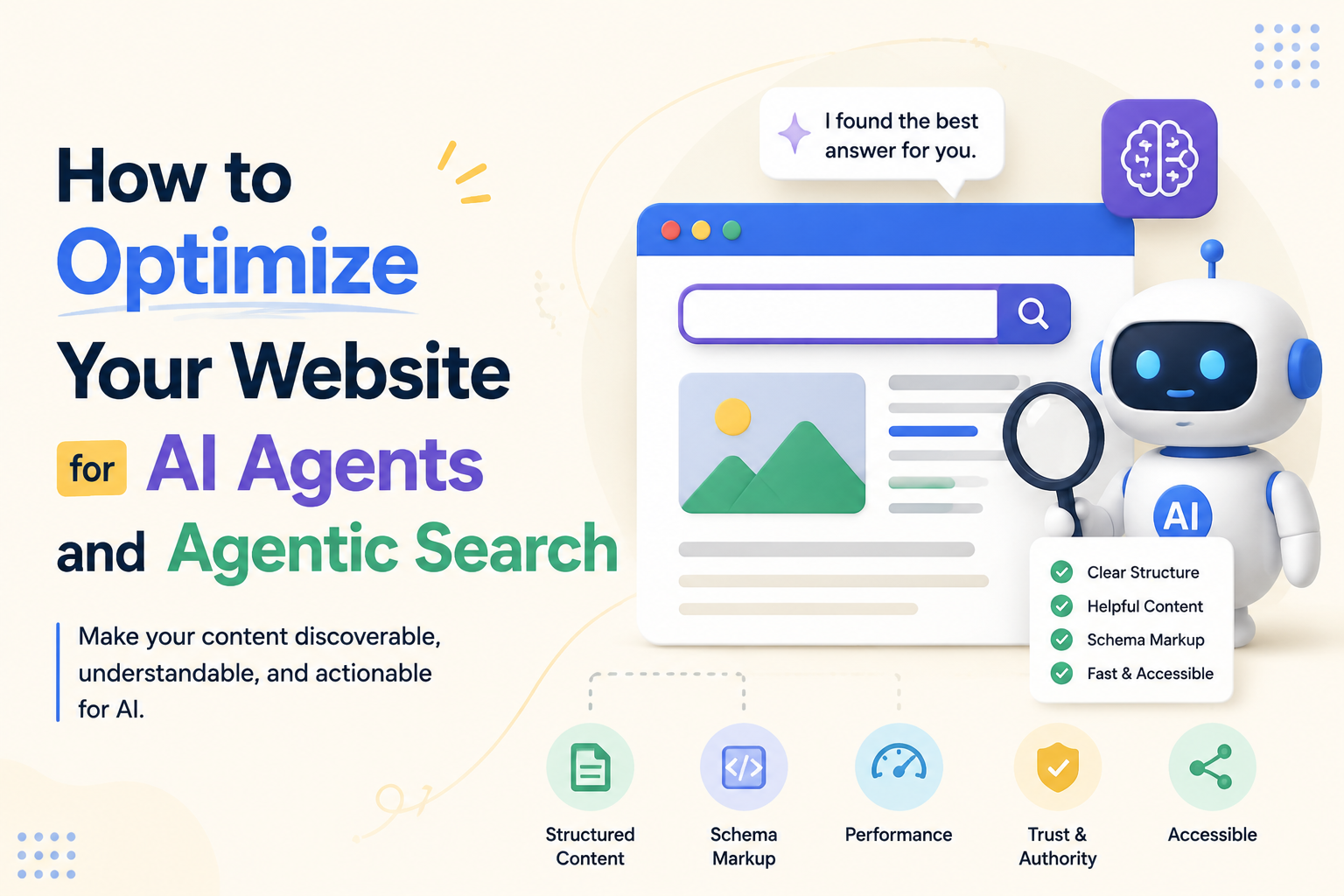
Have you ever wondered if your website is truly visible to the automated systems that now navigate the web on behalf of users? Most businesses focus on traditional rankings, but the digital landscape is shifting toward machine-mediated discovery. Being found by a human is no longer enough; ai agent optimization helps ensure your content is selected, cited, and utilized by modern software tools.
This transition requires a new approach to how we structure information online. We are moving beyond simple keywords into a world where ai agent optimization determines your relevance in automated research. This guide explores a comprehensive 13-step process to help your brand thrive in this new era.
Key Takeaways
- Understand the shift from standard search results to machine-driven answers.
- Learn why being cited by automated systems is the new gold standard for visibility.
- Discover how to structure your data for better machine readability.
- Prepare your digital presence for the rise of autonomous task completion.
- Follow our 13-step framework to ensure your content remains competitive.
Make Your Website AI-Ready
Discover practical strategies to help AI agents understand, trust, cite, and recommend your content across the rapidly evolving search landscape.
Understand How AI Agents and Agentic Search Discover Information
AI agents are transforming the web from a static library into an active, problem-solving environment. Unlike older search methods that simply return a list of links, a machine learning agent actively interprets user intent to provide direct answers or perform complex tasks. This evolution requires website owners to rethink how they present information to ensure it remains discoverable.
How Agentic Search Differs From Traditional Search
Traditional search engines rely heavily on keyword matching and backlink authority, while ai agent optimization focuses on broader contextual signals. In contrast, agentic search focuses on understanding the context behind a query to solve a specific problem. It prioritizes content that provides actionable solutions rather than just matching search terms.
This shift means that the quality of your content is no longer just about relevance. It is about how effectively your information can be synthesized into a coherent answer. Agents look for depth, accuracy, and the ability to support a user’s next logical step.
What AI Agents Need Before They Can Recommend a Website
To be recommended by an AI, your website must provide clear, accessible, and trustworthy data. A machine learning agent needs to parse your content without ambiguity to verify its accuracy. If your site lacks clear structure or uses confusing language, the agent may struggle to include your information in its final output.
Trustworthiness is equally vital for visibility and effective ai agent optimization. Agents prioritize sources that demonstrate expertise and provide verifiable facts. By using structured data and maintaining high editorial standards, you provide the necessary evidence for an agent to confidently cite your brand as a reliable source.
How Retrieval, Reasoning, and Task Completion Shape Visibility
Visibility in the age of AI and ai agent optimization is determined by three core forces: retrieval, reasoning, and task completion. Retrieval involves the system finding your content among billions of pages. Reasoning allows the agent to evaluate if your content actually answers the user’s specific question. Finally, task completion measures whether your information helps the user finish their goal.
| Feature | Traditional Search | Agentic Search |
|---|---|---|
| Primary Goal | Provide a list of links | Solve a user task |
| Content Focus | Keyword density | Context and utility |
| Output Format | Blue links | Direct answers/actions |
| Success Metric | Click-through rate | Task completion rate |
When these three forces align, your website becomes a preferred resource for the machine learning agent. By focusing on these elements, you ensure that your digital presence remains relevant as search technology continues to advance.
Set Strategic Goals for AI Agent Optimization
Developing a robust strategy for ai agent optimization begins with aligning your digital presence with specific user goals. Rather than chasing generic traffic, ai agent optimization requires you to focus on how machines interpret your content to solve real-world problems. This shift requires a clear understanding of the journey a user takes when interacting with an intelligent search interface.
Define the User Tasks Your Website Should Support
To succeed, identify the exact tasks your audience performs when they engage with your brand. Are they looking for quick facts, comparing product specifications, or seeking professional advice? By mapping these tasks, you support ai agent optimization and ensure your content provides the precise answers that AI systems prioritize.
Focus on the intent behind the query rather than just the keywords. When your content directly facilitates a task, such as booking a service or calculating a cost, you become a more valuable source for ai agent optimization and agent recommendations.
Map Business Outcomes to Agentic Search Visibility
Visibility in an agent-driven environment is only useful if it drives meaningful business results. You should connect your ai agent optimization efforts to key performance indicators like lead quality, customer acquisition costs, and long-term retention. This alignment ensures that your technical and content investments support your bottom line.
Choose Performance Metrics Beyond Rankings and Click-Through Rates
Traditional metrics often fail to capture the nuance of how users interact with AI-generated responses. You need a new framework for ai agent optimization to evaluate success in this evolving landscape.
Track Citations, Referrals, Completed Actions, and Assisted Conversions
Success is now measured by how often an agent cites your brand as a primary source. Monitor the following indicators to gauge your effectiveness:
- Citations: Frequency of your brand being mentioned as an authoritative answer.
- Referrals: Traffic originating from direct links within an AI response.
- Completed Actions: Users finishing a purchase or form submission after an AI-assisted discovery.
- Assisted Conversions: Instances where an AI interaction played a role in the final decision-making process.
Separate Branded, Nonbranded, and Conversational Discovery
It is essential to categorize your visibility as part of ai agent optimization to understand where your brand stands. Branded discovery tracks how often agents mention you by name, while nonbranded discovery measures your authority on specific topics. Finally, conversational discovery highlights your ability to provide helpful answers during complex, multi-step user inquiries.
Build a Website Architecture That AI Agents Can Navigate
To succeed with ai agent optimization, you must build a digital environment that machines find intuitive. Implementing effective ai agent optimization techniques ensures that automated systems can crawl, index, and understand the relationships between your pages. A well-structured site acts as a reliable map for AI agents, allowing them to extract accurate information efficiently.
Create Clear Content Hubs and Logical Internal Links
Content hubs organize your information into thematic clusters, which helps agents identify your topical authority. By linking related articles to a central pillar page, you create a clear hierarchy that machines can easily follow. This logical flow of internal links is one of the most powerful ai agent optimization techniques for improving discoverability.
Use Descriptive URLs, Breadcrumbs, and Consistent Navigation
Descriptive URLs provide immediate context to both users and AI agents about the content of a page, supporting ai agent optimization. When you combine these with breadcrumb navigation, you offer a clear trail that defines the site structure. Consistent navigation menus further reinforce these relationships, ensuring that no part of your site feels isolated or disconnected.
Connect Related Pages With Contextual Anchor Text
Contextual anchor text provides the necessary semantic signals that explain why two pages are related. Instead of using generic phrases like “click here,” use descriptive keywords that summarize the destination content. This practice helps ai agent optimization build a more accurate knowledge graph of your website’s offerings.
Prevent Orphan Pages and Conflicting Versions of the Same Content
Orphan pages are invisible to most automated discovery tools because they lack incoming links. You must audit your site regularly to ensure every important page is linked within your primary navigation or hub structure. Additionally, avoid creating conflicting versions of the same content, as this confuses agents and dilutes your authority.
Design Landing Paths for Research, Comparison, and Conversion Tasks
AI agents often look for specific paths that guide users through a decision-making process. By designing clear landing paths for research, comparison, and conversion, you reduce ambiguity for the machine. These paths should clearly label the intent of each page, making it easier for agents to recommend your site for specific user queries.
| Architecture Element | Primary Benefit | Impact on AI Agents |
|---|---|---|
| Content Hubs | Topical Authority | High discovery rate |
| Breadcrumbs | Structural Clarity | Improved pathing |
| Contextual Links | Semantic Relevance | Better entity mapping |
| Landing Paths | Task Completion | Higher conversion potential |
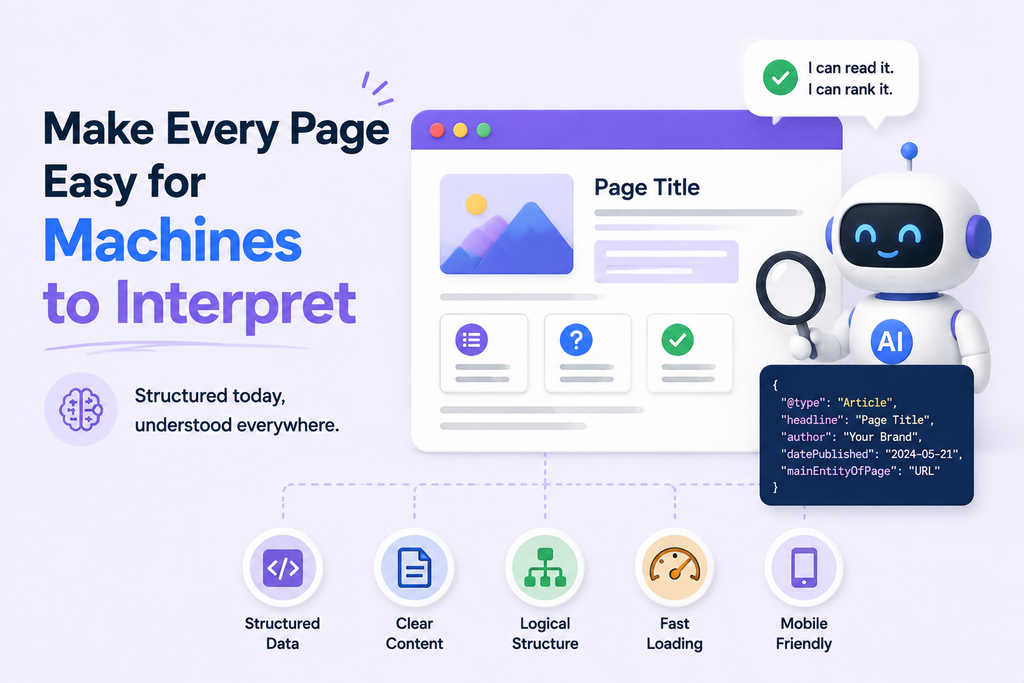
Make Every Page Easy for Machines to Interpret
To succeed in an era of automated discovery, your website must speak the language of algorithms fluently. Effective ai agent optimization strategies rely on providing clear, unambiguous signals that allow machines to parse your content without guesswork. By prioritizing structure, you ensure that your brand remains visible and accurate within complex search visbility ecosystems.
Write Precise Titles, Headings, and Page Summaries
For effective ai agent optimization, search agents prioritize content that clearly defines its purpose from the start. Use descriptive titles and headings that act as a roadmap for the information contained on the page. A concise summary at the top of your content helps automated systems quickly verify the relevance of your page to a specific user query.
Organize Facts With Structured HTML and Semantic Elements
Semantic HTML provides the necessary context for machines to understand the hierarchy of your information. By using tags like <article>, <section>, and <aside>, you define the role of each content block. This structural clarity is a core component of modern ai agent optimization strategies.
“Data is the fuel for the next generation of search, but only if that data is structured in a way that machines can trust and verify.”
Implement Relevant Schema.org Structured Data
Schema markup acts as a formal language that supports ai agent optimization by describing your content to search engines. It transforms raw text into machine-readable entities, making it easier for agents to extract key facts.
Apply Article, Product, Organization, LocalBusiness, and FAQPage Markup Carefully
You should select the schema type that best matches the intent of your page. For instance, using FAQPage markup for a list of common questions helps agents pull direct answers into their responses. The following table outlines how different schema types support specific business goals:
| Schema Type | Primary Purpose | Agent Benefit |
|---|---|---|
| Article | News and blog content | Improved topical authority |
| Product | E-commerce items | Price and availability data |
| LocalBusiness | Physical locations | Verified contact details |
Keep Structured Data Consistent With Visible Page Content
Accuracy is vital when implementing structured data. If your schema claims a product price that differs from the visible text on the page, you risk losing the trust of the AI agent. Always ensure that your markup reflects the actual user experience.
Clarify Entities, Attributes, Relationships, and Definitions
Beyond simple markup, ai agent optimization requires you to define the relationships between entities on your site. Clearly state who your organization is, what products you offer, and how these items relate to one another. By defining these attributes, you provide the context necessary for agents to build a complete picture of your brand, further strengthening your ai agent optimization strategies.
Create Content That Answers Complete User Tasks
Designing content for agentic search means anticipating the full scope of a user’s journey. When a machine learning agent processes a request, it looks for information that solves a problem from start to finish. Providing fragmented data often leads to poor visibility in automated results, making ai agent optimization more difficult.
Match Content to Conversational and Multistep Search Intent
Users often interact with AI through natural language, asking follow-up questions that build on previous context. Your content should mirror this flow by addressing the logical progression of a task. A machine learning agent performs best when it can extract sequential steps from your pages.
Answer the Core Question Before Adding Supporting Detail
Prioritize the most direct answer to the user’s query at the very top of your page. By providing a concise summary first, you help the machine learning agent identify the primary value of your content immediately. You can then expand with deeper analysis, background information, or technical specifications.
Cover Constraints, Alternatives, Costs, Timelines, and Next Actions
Complete answers are essential for ai agent optimization because they must account for the reality of the user’s situation. Include details about potential limitations, budget requirements, and estimated timeframes to provide a holistic view. This level of detail helps the system evaluate if your solution fits the user’s specific needs.
Use Tables, Lists, and Decision Criteria Where They Improve Comprehension
Structured data formats allow systems to parse complex information quickly. Using tables to compare options or lists to outline steps makes your content significantly more accessible.
| Feature | Basic Plan | Pro Plan | Enterprise |
|---|---|---|---|
| Cost | $0/mo | $29/mo | Custom |
| Support | Priority | Dedicated | |
| Timeline | Instant | 24h Setup | Consultation |
Address Ambiguous Queries With Clearly Labeled Scenarios
When a query is broad, use scenarios to clarify which solution applies to which user. Clearly labeling these sections helps the system map the right content to the right user intent. This reduces the chance of the AI providing a generic or irrelevant response.
Demonstrate Firsthand Expertise and Verifiable Experience
Trust is a critical factor for any machine learning agent when selecting sources. Showcase your firsthand experience by citing original research, case studies, or personal testing results. Verifiable evidence proves that your content is based on real-world application rather than theoretical assumptions.
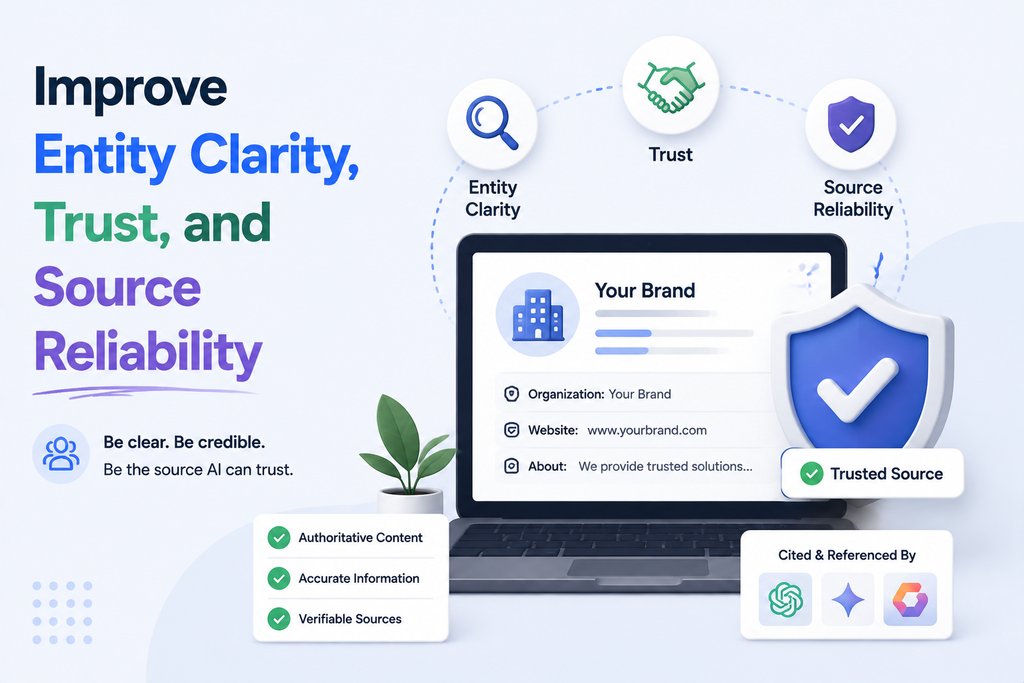
Improve Entity Clarity, Trust, and Source Reliability
AI agents prioritize sources that demonstrate high levels of authority and transparency. When an seo optimizer ai agent evaluates your content, it looks for clear signals that verify who you are and why your information is credible. Establishing this digital trust is essential for maintaining visibility in modern search environments.
Establish Consistent Organization and Author Entities
You must define your organization and authors as distinct entities using structured data. By implementing Schema.org markup, you provide machines with a clear map of your brand’s identity and its contributors. This consistency helps an seo optimizer ai agent link your content to verified professional profiles.
Publish Transparent Author Bios, Editorial Policies, and Contact Details
Transparency is a core requirement for ai agent optimization and building long-term credibility. Every piece of content should feature a detailed author bio that highlights relevant expertise and credentials. Furthermore, publishing clear editorial policies and accessible contact information proves that your site is managed by real, accountable humans.
Support Claims With Primary Sources and Reputable References
Accuracy is non-negotiable for ai agent optimization when you want to be cited by intelligent systems. Always link to primary research, official government data, or peer-reviewed studies to back up your assertions. Providing verifiable evidence ensures that your site remains a trusted resource for automated research tools.
Display Publication Dates, Update Dates, and Meaningful Revision Notes
Search systems need to know if your information is current. Displaying clear publication and last-updated dates helps agents understand the relevance of your content. Adding brief revision notes explains what changed, which builds further confidence in your commitment to accuracy.
Correct Outdated Facts and Retire Content That Can Mislead Agents
Stale information can damage your reputation and confuse automated systems. Regularly audit your pages to identify and correct outdated statistics or claims. If a page no longer serves a purpose or contains obsolete data, it is better to retire it than to leave it active.
Strengthen Brand Recognition Across Owned and Trusted External Channels
Your brand’s footprint should extend beyond your own domain. Maintain consistent profiles on industry-specific platforms and reputable social channels to reinforce your entity status. This cross-channel presence helps an seo optimizer ai agent validate your authority through multiple trusted sources.
| Trust Signal | Purpose | Impact on AI |
|---|---|---|
| Author Schema | Verify expertise | High |
| Editorial Policy | Ensure accountability | Medium |
| Primary Citations | Validate accuracy | High |
| Revision History | Confirm freshness | Medium |
Optimize Technical Performance for AI Agent Access
Your website’s technical health directly dictates how easily AI agents can access and process your public information. Implementing effective optimization techniques ensures that your content remains discoverable in an increasingly automated search landscape.
Ensure Important Content Is Available Without Client-Side Rendering Failures
Many modern websites rely heavily on JavaScript to display content. If an AI agent cannot execute this code, your primary information may remain invisible to the system.
You should prioritize server-side rendering or static site generation for critical data. This approach guarantees that the raw HTML contains all necessary facts, allowing agents to parse your content without relying on complex browser-side execution.
Improve Core Web Vitals, Mobile Usability, and Server Response Times
Fast, stable websites provide a better foundation for ai agent optimization and a better experience for both human users and automated crawlers. Improving your server response times reduces the latency that agents encounter when requesting your pages.
Focusing on Core Web Vitals such as Largest Contentful Paint and Cumulative Layout Shift—helps machines interpret your page structure more reliably. Furthermore, mobile usability remains a standard requirement, as many agents simulate mobile environments to assess content relevance.
Manage Robots.txt, XML Sitemaps, Canonicals, and Indexability
Clear instructions are vital for guiding automated systems through your site architecture. Your robots.txt file should explicitly permit access to high-value content while blocking unnecessary directories.
Allow Appropriate Crawlers to Access Valuable Public Resources
Ensure that your XML sitemaps are updated regularly to reflect new or modified pages. Using canonical tags correctly prevents duplicate content issues, which helps agents focus their processing power on your most authoritative versions.
Protect Private Data, Account Areas, and Transactional Functions
While ai agent optimization aims to improve visibility, you must also secure sensitive information. Use robots.txt directives to restrict access to user dashboards, checkout flows, and private account areas to prevent unauthorized indexing.
Test Pages Across Browsers, Devices, and Rendering Conditions
Regular testing is a core component of successful ai agent optimization techniques. You should verify that your pages render correctly across various simulated environments to ensure consistency.
| Technical Metric | Goal for AI Agents | Impact Level |
|---|---|---|
| Server Response | Under 200ms | High |
| Rendering | Server-Side Ready | Critical |
| Mobile View | Fully Responsive | High |
| Crawl Access | Clear Robots.txt | Critical |
By maintaining these standards, you create a reliable foundation for AI agents. Consistent technical performance acts as a signal of quality, ensuring your site remains a preferred source for automated search results.
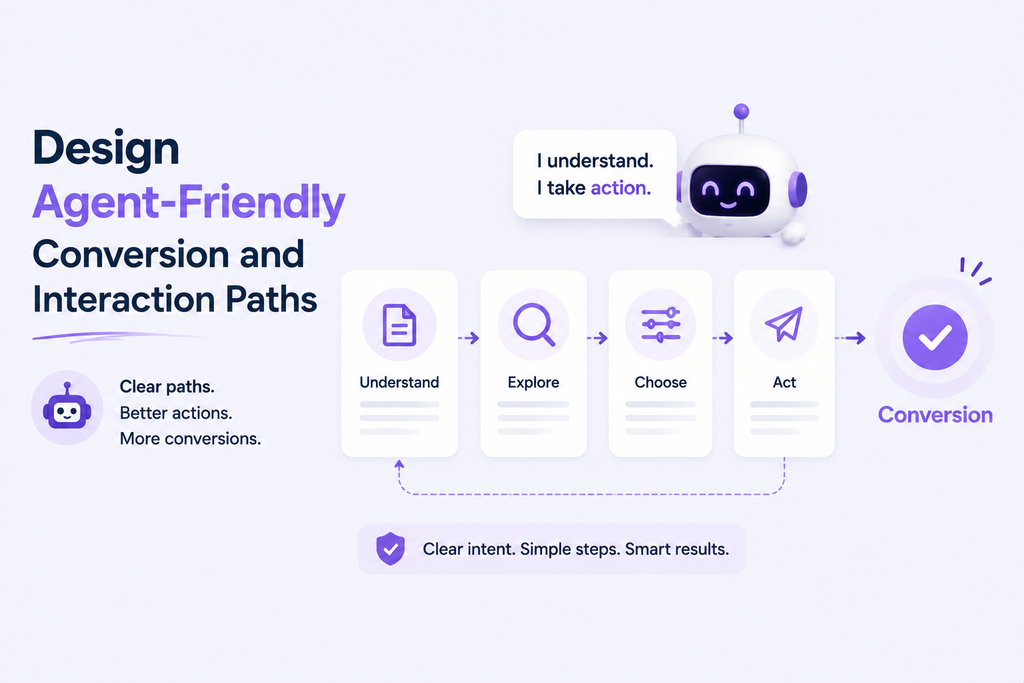
Design Agent-Friendly Conversion and Interaction Paths
Optimizing interaction paths is essential for maintaining high ai agent performance. When automated systems attempt to complete tasks on your site, they rely on clear, predictable pathways to navigate from discovery to conversion. By simplifying these journeys, you ensure that agents can successfully execute actions on behalf of users.
Make Calls to Action Specific, Visible, and Contextually Relevant
Agents interpret buttons and links based on their labels and surrounding context. Use descriptive text that clearly indicates the outcome of an action, such as “Book Appointment” or “Download Pricing Guide,” rather than generic phrases like “Click Here.” Contextual relevance helps the agent understand the purpose of the interaction within the broader user task.
Reduce Friction in Forms, Checkout, Booking, and Lead Qualification
Complex forms often act as barriers to automated completion. Streamline your lead qualification and checkout processes by requesting only essential information. A reduction in unnecessary steps directly improves ai agent performance by minimizing the risk of errors during data submission.
Use Stable Labels and Predictable Form Field Behavior
Consistency is vital for machine interpretation. Ensure that form labels remain static and that input fields follow standard HTML conventions. When fields behave predictably, agents can map user data accurately without encountering validation failures.
Provide Human-Friendly Alternatives When Agents Cannot Complete a Task
Not every interaction can be fully automated. If an agent reaches a point where it cannot proceed, provide a clear path for the user to take over. Offering a direct link to a support chat or a human-staffed contact page ensures that the user experience remains positive even when automation hits a limit.
Expose Pricing, Availability, Policies, and Eligibility Requirements Clearly
Transparency is a cornerstone of agentic search. Clearly display your pricing structures, current availability, and service policies in structured formats. When this information is easy to parse, agents can provide accurate answers to users without needing to scrape hidden or complex elements.
Use APIs and Structured Feeds for Real-Time Information Where Appropriate
For dynamic data like inventory or real-time scheduling, rely on APIs or structured feeds. These methods provide a direct, reliable way for agents to access current information. By exposing data through these channels, you significantly boost ai agent performance and ensure that the information presented to the end user is always up to date.
Turn AI Visibility Into Business Growth
Optimize your website’s structure, content, and conversion paths so AI agents can discover your brand and guide users toward meaningful actions.
Apply AI Optimization Strategies Without Sacrificing Search Quality
Effective ai optimization strategies demand a human-centric approach to maintain long-term authority. While technology offers powerful tools for scaling production, the human element remains the final arbiter of quality. Balancing these forces ensures your brand remains trustworthy in the eyes of both users and search systems.
Use Generative AI to Research and Organize, Not to Replace Editorial Judgment
Generative tools excel at synthesizing vast amounts of data and structuring complex information. Use these systems to identify content gaps, outline articles, or summarize technical documentation. However, never allow an algorithm to dictate the final narrative or strategic direction of your content.
Editorial judgment involves understanding the nuance of your audience’s needs. Machines lack the lived experience required to provide unique insights or emotional resonance. Always treat AI output as a draft that requires a human editor to refine the tone and perspective.
Review AI-Assisted Content for Accuracy, Originality, and Brand Relevance
Every piece of content generated with machine assistance must undergo a rigorous verification process. Check all facts against primary sources to prevent the spread of hallucinations or outdated information. Originality is your competitive advantage, so ensure the final output reflects your unique brand voice rather than generic patterns.
Consider the following comparison to maintain high standards in your production workflow:
| Process Step | AI Role | Human Role |
|---|---|---|
| Topic Research | Data Aggregation | Strategic Selection |
| Drafting | Structure & Outlining | Tone & Narrative |
| Fact Checking | Pattern Matching | Source Verification |
| Final Approval | None | Brand Alignment |
Avoid Scaled Low-Value Pages, Keyword Stuffing, and Manipulative Markup
Mass-producing content to capture search traffic often leads to a decline in site quality. Avoid creating thin pages that offer little value to the reader. Furthermore, avoid keyword stuffing or using hidden text to manipulate search rankings, as these tactics trigger penalties and erode user trust.
Set Human Review Standards for Sensitive, Regulated, and High-Stakes Topics
Topics involving health, finance, or legal advice require specialized oversight. Implement a mandatory review by subject matter experts for any content that impacts a user’s well-being. These ai agent optimization strategies must prioritize safety and accuracy above speed or volume.
Document Content Sources, Reviewers, and Approval Criteria
Transparency builds credibility with both users and search engines. Maintain a clear record of who researched, wrote, and approved each piece of content. Documenting your sources and the criteria used for approval creates a verifiable trail of accountability that strengthens your brand’s reputation.
Measure AI Agent Performance and Refine the Optimization Process
To master the evolving landscape of search, you must implement a rigorous ai agent optimization framework for measuring ai agent performance. Without a clear understanding of how your site interacts with these systems, you cannot effectively refine your strategy or improve your visibility.
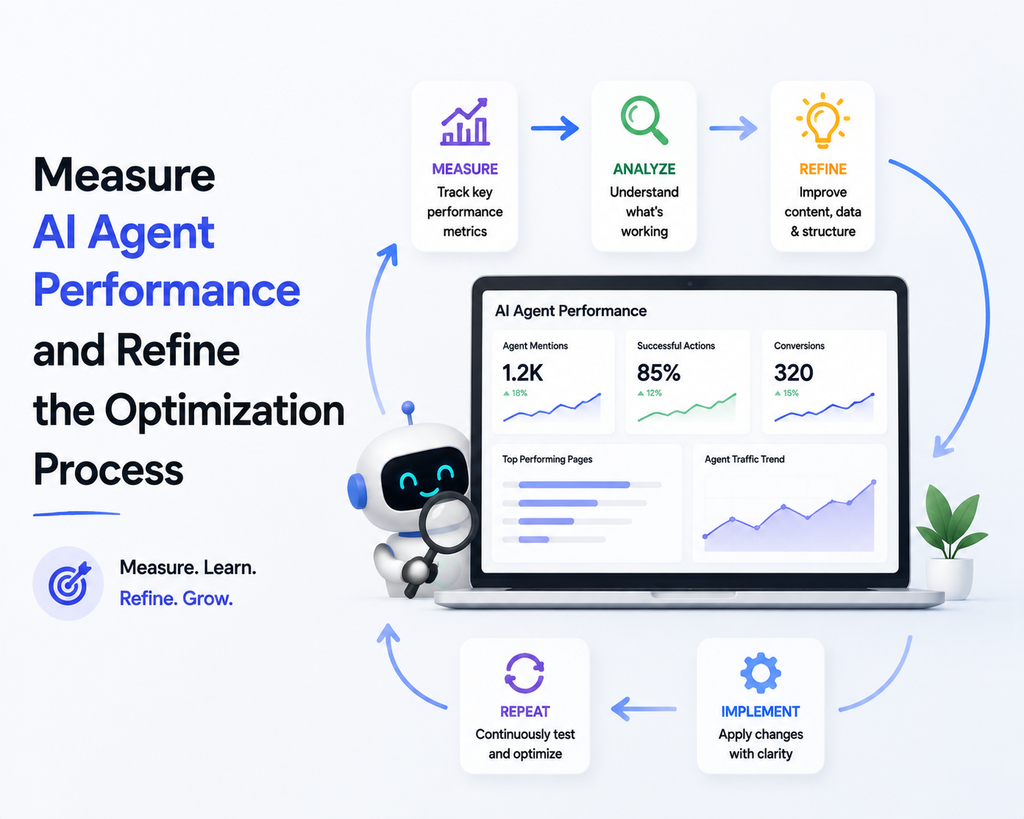
Establish a Baseline Before Changing Content or Technical Signals
Before you implement any major updates, document your current standing across various AI platforms. A solid baseline allows you to isolate the impact of specific changes, such as schema updates or content restructuring.
Record your current citation frequency and the specific queries that trigger your site as a source. This historical data serves as the foundation for all future optimization efforts.
Monitor Agent Citations, Answer Inclusion, and Referral Quality
Tracking ai agent performance involves more than just checking rankings. You must analyze whether your content is being cited as a primary source or merely as a secondary reference.
- Citation Frequency: How often does the agent link to your domain?
- Answer Inclusion: Is your content used to construct the direct answer?
- Referral Quality: Are the users arriving from these agents engaging with your site?
Run Prompt-Based Tests for Brand, Product, and Problem-Focused Queries
Active testing is the most reliable way to gauge how your brand is perceived by machine learning models. Create a set of standardized prompts that reflect real user behavior to ensure consistent results.
Compare Results Across Google AI Overviews, Microsoft Copilot, and Perplexity
Different models prioritize different signals, so testing across multiple platforms is vital. Use the following table to track how your brand performs in these unique environments.
| Platform | Primary Focus | Metric to Track |
|---|---|---|
| Google AI Overviews | Information Retrieval | Snippet Inclusion |
| Microsoft Copilot | Conversational Depth | Citation Accuracy |
| Perplexity | Source Reliability | Domain Authority |
Record Incorrect Answers, Missing Context, and Unclear Source Attribution
When an agent provides a response, look for gaps in the information provided. Note any instances where the model fails to attribute your content correctly or omits critical context that your page provides.
These errors are not just technical glitches; they are opportunities to clarify your structured data or refine your content summaries. Documenting these issues helps you identify where the AI is struggling to interpret your site’s intent.
Prioritize Improvements by User Impact, Effort, and Business Value
Once you have gathered your data, you must decide which issues to address first. Focus on changes that offer the highest ai agent performance gains relative to the time required to implement them.
Prioritize fixes that directly impact user trust and conversion paths. By aligning your technical and content updates with these high-impact areas, you ensure that your website remains a reliable and preferred source for AI-driven search.
Turn AI Agent Optimization Into an Ongoing Website Program
Establishing a repeatable process ensures your brand remains relevant as search technology evolves. Rather than viewing ai agent optimization as a single project, organizations must integrate these practices into their daily operations. This shift transforms how teams interact with search engines and machine-driven discovery platforms.
Create a Cross-Functional Workflow for SEO, Content, Development, and Legal Teams
Effective governance requires input from multiple departments to ensure accuracy and compliance. SEO teams provide the strategic direction, while content creators ensure the messaging remains on-brand. Developers handle the technical implementation, and legal teams verify that all claims meet regulatory standards.
By establishing a unified workflow, you prevent silos that often hinder performance. Regular meetings allow these groups to align on goals and address potential roadblocks before they impact your visibility. This collaborative approach acts as a robust seo optimizer ai agent strategy that scales with your business needs.
Schedule Technical Audits, Content Reviews, and Agent Visibility Checks
Consistency is the foundation of long-term success in modern search environments. You should schedule quarterly technical audits to identify potential crawl errors or rendering issues. Additionally, monthly content reviews ensure that your information remains accurate and competitive.
Visibility checks involve monitoring how machines interpret your site compared to competitors. If you notice a drop in performance, these scheduled reviews allow for rapid adjustments. This proactive stance is a hallmark of a mature ai agent optimization program.
Update Internal Guidelines as Agentic Search Capabilities Change
Search technology is not static, and your internal documentation for ai agent optimization should reflect this reality. As new features emerge, update your style guides and technical requirements to match current best practices. This ensures that every team member understands their role in maintaining high-quality signals for machines.
Maintain a Shared Inventory of Important Entities, Claims, and Data Sources
A centralized repository of your brand’s core facts is essential for consistency. This inventory should include verified entities, primary data sources, and approved claims. By keeping this information in one place, you ensure that every piece of content remains aligned with your core identity.
Use Test Queries to Validate Changes Before and After Publication
Before pushing major updates, run controlled test queries to see how machines respond to your content. This validation step helps you refine your approach and catch potential issues early. Using a reliable seo optimizer ai agent framework for testing minimizes risk and maximizes the impact of your efforts.
| Activity | Frequency | Primary Owner |
|---|---|---|
| Technical Audit | Quarterly | Development/SEO |
| Content Accuracy Review | Monthly | Content/Legal |
| Entity Inventory Update | Bi-Annually | SEO/Strategy |
| Agent Visibility Testing | Ongoing | SEO/Analytics |
Stay Ahead of Agentic Search
Put your AI agent optimization strategy into action with a structured framework designed to improve visibility, credibility, citations, and long-term digital performance.
Conclusion
The shift toward intelligent discovery changes how users interact with your digital presence. Success requires a commitment to ai agent optimization that goes beyond traditional search engine tactics. You must align your technical infrastructure, content strategy, and entity data to meet the specific needs of autonomous systems.
Building a sustainable framework involves your entire organization. Marketing, development, and legal teams play vital roles in maintaining the clarity and reliability of your information. Consistent updates ensure your brand remains a trusted source as search technology evolves.
Prioritize ongoing testing to stay ahead of shifting agent behaviors. Regular audits help you refine your approach and maintain visibility in a competitive landscape. Effective ai agent optimization serves as the foundation for long-term growth in this new era of digital interaction.
Start by evaluating your current data signals and user task completion paths today. Small adjustments to your architecture and structured data can strengthen ai agent optimization and yield significant improvements in how machines interpret your value. Your proactive efforts today define your authority in the intelligent search ecosystem of tomorrow.
FAQs
What is AI agent optimization and why is it necessary for modern websites?
AI agent optimization is the strategic process of configuring a website to be more discoverable and interpretable by automated systems and agentic search tools. As users shift toward tools like Perplexity and ChatGPT for research and task completion, websites must move beyond traditional keyword rankings. Optimization ensures that your content is not just indexed, but actively selected, cited, and used by a machine learning agent to satisfy complex user requests.
How does a machine learning agent discover and process website information differently than a traditional search engine?
Traditional search engines primarily focus on indexing and retrieval based on keywords. In contrast, a machine learning agent utilizes retrieval, reasoning, and task completion to synthesize answers. These systems look for clear, trustworthy evidence to support their conclusions. By using specific optimization techniques like structured semantic HTML and clear entity definitions, you provide these agents with the context they need to recommend your site during a conversational search.
What are the most effective ai optimization strategies for improving visibility in Google AI Overviews and Microsoft Copilot?
Effective ai optimization strategies involve a combination of technical precision and authoritative content. Key tactics include implementing Schema.org markup (such as Article, Product, and FAQPage), maintaining a logical internal linking structure through content hubs, and ensuring that primary questions are answered concisely at the beginning of your content. This helps Google AI Overviews and Microsoft Copilot quickly extract the facts needed for their summaries.
How can I measure ai agent performance if traditional click-through rates are declining?
To accurately gauge AI agent performance, businesses must track new metrics such as citation frequency, brand mentions in conversational AI responses, and assisted conversions. Instead of focusing solely on Google Search Console clicks, monitor how often your site is used as a source in agentic search environments and evaluate the quality of referral traffic originating from AI platforms.
What role does a seo optimizer AI agent play in modern digital marketing?
An seo optimizer ai agent refers to specialized software or automated workflows designed to audit and refine content for better machine readability. These agents can identify missing Schema.org attributes, detect outdated facts that might mislead a crawler, and suggest optimization techniques to ensure that your website architecture—including breadcrumbs and anchor text is perfectly aligned with how AI systems navigate the web.
Which technical optimization techniques are essential for ensuring AI agents can access my content?
Technical accessibility is a pillar of ai agent performance. You must ensure that your content is available without client-side rendering failures and that your Robots.txt and XML sitemaps explicitly allow access to valuable public resources. Improving Core Web Vitals and server response times also ensures that a machine learning agent can quickly fetch and process your data without timeout errors or navigation friction.
How should I structure my content to support multistep conversational search intent?
Content should be designed to answer a complete task rather than just a single query. This involves covering constraints, alternatives, costs, and next actions. Using tables, bulleted lists, and decision criteria makes it easier for an seo optimizer ai agent to parse your data. Always provide a direct answer first, followed by firsthand expertise and verifiable evidence to build the “reasoning” data a machine learning agent requires.
How can I protect my brand’s reputation within AI-generated responses?
To maintain trust, focus on entity clarity. Establish consistent author bios, publish transparent editorial policies, and ensure that your brand information is uniform across LinkedIn, Crunchbase, and your own “About” pages. By correcting outdated facts and retiring misleading content, you reduce the risk of AI systems hallucinating or providing incorrect information about your company or products.