
Do you truly know the price you pay for every new client who walks through your door? Many business owners guess their marketing efficiency, but relying on intuition often leads to wasted budgets and missed growth opportunities.
Understanding this metric is a practical measure of your firm’s health. By mastering the math behind your spending, you gain the power to scale effectively while keeping your margins healthy.
This guide provides the standard formula, real-world business examples, and actionable strategies for improvement. If you are learning how to calculate acquisition cost, this guide provides the practical steps you need. We will explore how to pair these figures with revenue, gross margin, and lifetime value to ensure your long-term success.
Key Takeaways
- Customer acquisition metrics reveal the true efficiency of your marketing spend.
- Accurate results require matching total sales expenses with the exact number of new clients.
- You can improve profitability by optimizing your conversion funnels and lead quality.
- Comparing this data against lifetime value helps determine your sustainable growth ceiling.
- Regular analysis allows you to pivot strategies before your budget drains.
Acquisition Costs Into Smarter Grow
Stop guessing where your marketing budget goes. Discover smarter ways to calculate CAC, reduce wasted spending, and build a more profitable customer acquisition strategy.
What Customer Acquisition Cost Measures
Understanding the true cost of growth starts with a clear grasp of your acquisition metrics. Learning how to calculate acquisition cost gives you a practical starting point for measuring that growth. By tracking these figures, you gain visibility into how effectively your capital converts prospects into revenue-generating clients.
Define Customer Acquisition Cost in Business Terms
The customer acquisition cost is the average amount your company invests to secure one new paying customer during a specific measurement period. This metric serves as a vital health indicator for your marketing and sales operations. Learning how to calculate acquisition cost makes it easier to monitor this indicator consistently.
A precise CAC definition allows you to evaluate whether your current growth strategy is sustainable. Understanding how to calculate acquisition cost is the next step toward applying this definition to your business. When you maintain a consistent approach to this calculation, you can reliably compare performance across different timeframes, marketing channels, and customer segments. This consistency is especially valuable when learning how to calculate acquisition cost across multiple campaigns.
Distinguish CAC From CPA, Cost Per Lead, and Customer Lifetime Value
It is common to confuse various marketing metrics, but they serve distinct purposes. While CAC focuses on the total cost to gain a paying customer, other metrics measure different stages of the funnel:
- Cost Per Action (CPA): Measures the cost of a specific user interaction, such as a click or a sign-up.
- Cost Per Lead (CPL): Tracks the expense of acquiring a potential prospect who has not yet committed to a purchase.
- Customer Lifetime Value (CLV): Represents the total revenue you expect from a single customer throughout their entire relationship with your brand.
“The goal is not just to acquire customers, but to acquire them at a cost that allows for long-term profitability and sustainable scaling.”
Identify Which Acquisition Expenses Belong in the Calculation
To arrive at an accurate figure, you must include all relevant customer acquisition expenses. This is an important consideration when learning how to calculate acquisition cost accurately. Failing to account for the full scope of your spending often leads to an inflated sense of profitability.
Your calculation should incorporate the following costs:
- Advertising spend across all paid media platforms.
- Content production costs, including creative design and copywriting.
- Marketing and sales team payroll and commissions.
- Fees paid to external agencies or consultants.
- Software subscriptions and tools used specifically for acquisition efforts.
By aggregating these costs, you ensure that your data reflects the true investment required to grow your business. This complete view is essential when determining how to calculate acquisition cost for your business. Consistency in these inputs is the foundation of reliable financial analysis. It also makes it easier to understand how to calculate acquisition cost consistently from one reporting period to another.
How to Calculate Acquisition Cost With the CAC Formula
You can unlock significant business insights by learning how to calculate acquisition cost accurately. This process transforms raw spending data into a clear metric that guides your future investment decisions. It also gives you a practical framework for understanding how to calculate acquisition cost from your own data. By following a standardized approach, you ensure that your growth strategy remains grounded in reality.
Apply the Customer Acquisition Cost Formula
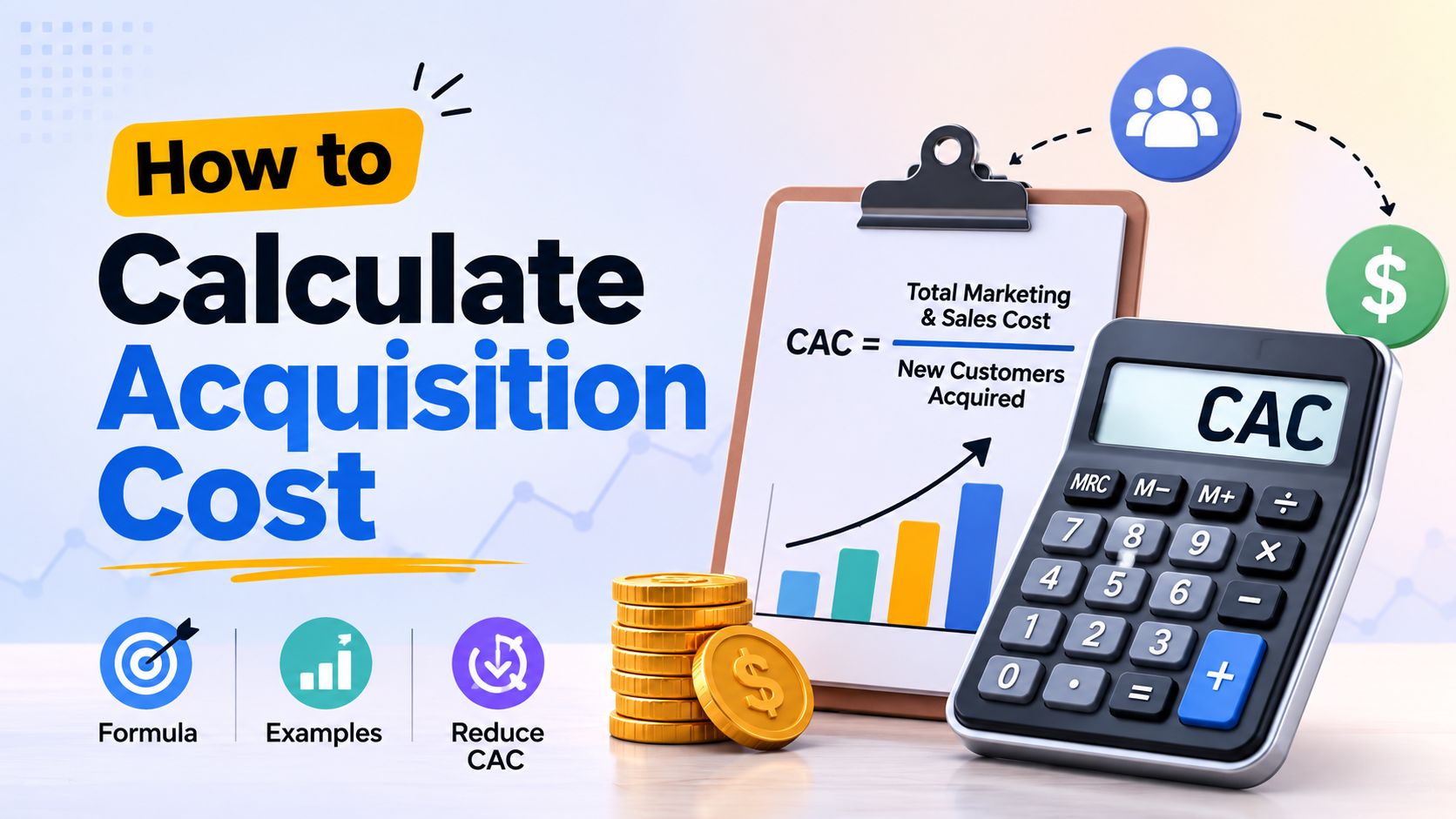
To calculate customer acquisition cost, you must divide your total sales and marketing expenses by the number of new customers gained during a specific timeframe. This simple ratio provides the baseline for evaluating your marketing efficiency. For anyone researching how to calculate acquisition cost, this ratio is the fundamental starting point.
Add Marketing and Sales Costs for a Specific Period
First, define a consistent measurement period, such as a month or a quarter. Choosing the right period is an important part of knowing how to calculate acquisition cost correctly. You must aggregate all relevant costs incurred during this window, including:
- Advertising spend across all digital and traditional platforms.
- Salaries and commissions for sales and marketing staff.
- Software subscriptions and creative production costs.
- Agency fees and third-party consulting expenses.
Divide Total Acquisition Spending by New Customers Acquired
Once you have your total expenditure, divide that figure by the total number of new customers acquired in that same period. It is vital to use verified new-customer counts rather than raw lead numbers or total transactions. This distinction is especially important when determining how to calculate acquisition cost from real business results. Using accurate customer data prevents you from inflating your success and ensures your math reflects actual business growth.
Choose Between Blended CAC and Channel-Specific CAC
You should distinguish between blended and channel-specific metrics to gain a complete view of your performance. Blended CAC provides an average cost across your entire business, which is useful for high-level financial reporting. In contrast, channel-specific CAC isolates the performance of individual sources like social media, search ads, or email marketing.
By comparing these two, you can identify which channels are over-performing and which are draining your budget. This comparison also makes how to calculate acquisition cost more useful for channel-level decisions. This granular view allows you to reallocate resources toward the most profitable acquisition paths. Knowing how to calculate acquisition cost at this level makes those budget decisions more precise.
Understand the Difference Between Historical and Marginal CAC
The CAC formula can be applied in two distinct ways depending on your goals. Historical CAC looks at the average cost of all customers acquired over a past period, offering a retrospective look at your efficiency. Marginal CAC, however, measures the cost of acquiring the next set of customers. Knowing how to calculate acquisition cost in both ways gives you a more complete view of growth efficiency.
Understanding marginal costs helps you determine if scaling your current efforts will lead to diminishing returns. While historical data tells you where you have been, marginal analysis helps you predict the cost of future growth.
Collect the Data You Need Before Calculating CAC
Establishing a clear data foundation is the most critical step in measuring your true acquisition spending. A reliable data foundation is also necessary when learning how to calculate acquisition cost. Without a structured approach to gathering your inputs, your final metrics will likely be skewed or misleading. By centralizing your customer acquisition data, you gain the visibility required to make informed budget decisions.
Set a Consistent Measurement Period
You must define a specific timeframe for your analysis to ensure your costs align with your results. Whether you choose a monthly, quarterly, or campaign-based window, consistency is vital for tracking trends over time.
If you compare costs from one month against customer counts from a different period, your math will fail. Always ensure that the expenses incurred during a specific window are matched against the new customers acquired during that exact same timeframe. This matching process is a core part of understanding how to calculate acquisition cost accurately.
Group Advertising, Content, Tools, Payroll, and Agency Costs
To get a complete picture of your investment, you need to aggregate all relevant expenses. Many businesses make the mistake of only counting ad spend, which ignores the hidden costs of running a marketing department.
Use this checklist to ensure your CAC data collection is comprehensive:
- Advertising Platforms: Total spend on Google Ads, Meta, or LinkedIn.
- Content Production: Costs for freelance writers, designers, and video editors.
- Marketing Tools: Monthly subscriptions for automation software and analytics platforms.
- Payroll: Salaries for the marketing and sales staff dedicated to acquisition.
- Agency Fees: Retainers or performance-based payments to external partners.
Count New Customers Using Reliable CRM and Sales Data
When calculating your final figures, rely strictly on verified transaction records. Avoid using vanity metrics like impressions, clicks, or total leads, as these do not represent actual revenue-generating customers.
Your CRM, billing system, or order database should serve as the single source of truth. Ensure you filter out duplicate contacts or test accounts to maintain the integrity of your customer acquisition data. Accurate counts are the bedrock of reliable financial reporting. They are equally important when determining how to calculate acquisition cost without distorting the results.
Match Acquisition Costs to the Correct Attribution Model
The way you assign credit to your marketing channels significantly impacts your final results. Different attribution models provide unique insights into how your acquisition spending influences the buyer journey.
Consider these common models:
- First-Touch: Attributes the customer to the very first channel they interacted with.
- Last-Touch: Gives full credit to the final channel before the conversion.
- Multi-Touch: Distributes credit across all touchpoints in the funnel.
- Blended: Averages all costs across all customers for a high-level view.
Choosing the right model depends on your business goals. It also affects how you interpret the results when determining how to calculate acquisition cost for each channel. While blended models are simple to calculate, multi-touch models often provide a more nuanced understanding of which channels truly drive growth.
Calculate CAC With Clear Business Examples
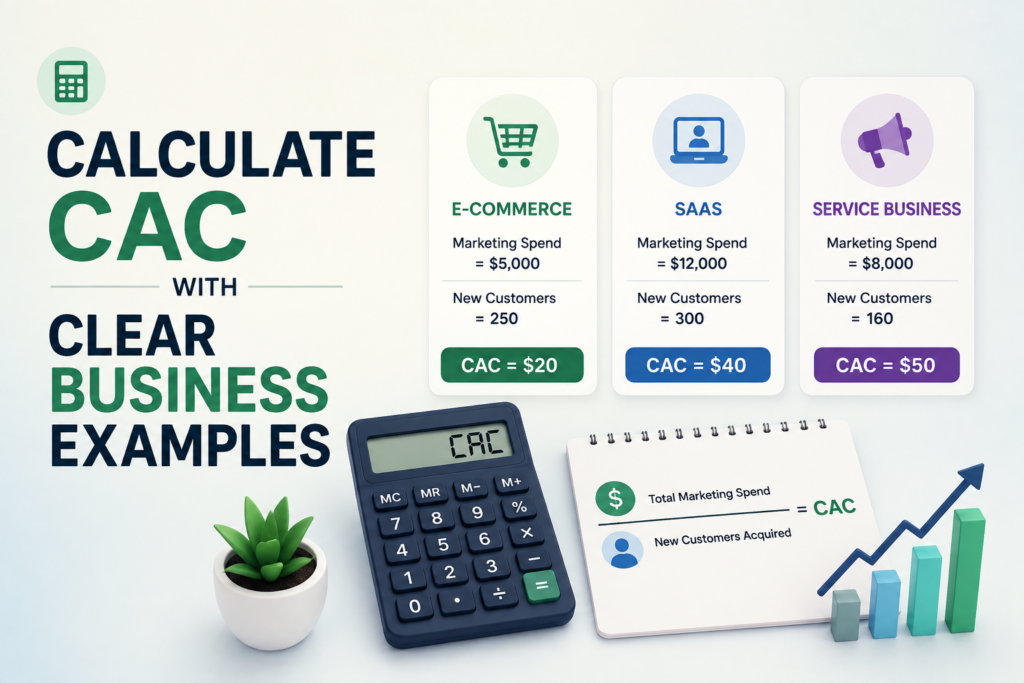
Applying the right formula to your specific business model is essential for accurate financial planning. This is why businesses should understand how to calculate acquisition cost for their particular model. By reviewing concrete CAC examples, you can better understand how to allocate your resources and measure the success of your growth efforts.
Calculate CAC for an E-Commerce Store
Combine Paid Advertising, Creative, and Marketing Labor Costs
For an e-commerce brand, your total acquisition cost includes more than just the price of a click. You must aggregate your monthly spend on social media ads, search engine marketing, and the production costs for your creative assets. Additionally, include a portion of the marketing team’s payroll to reflect the labor required to manage these campaigns.
Divide the Total by First-Time Buyers
Once you have your total monthly investment, divide that figure by the number of new customers acquired during that same period. This is the key calculation to remember when learning how to calculate acquisition cost. It is vital to only count first-time buyers to avoid skewing your data with repeat purchases. This simple division provides a clear snapshot of what it costs to bring a new shopper into your ecosystem. For e-commerce businesses, knowing how to calculate acquisition cost this way helps clarify the true cost of gaining first-time buyers.
Calculate CAC for a Subscription Software Company
Include Sales Salaries, Commissions, and Software Expenses
Subscription businesses often have higher overhead due to complex sales processes. You should include the full cost of your sales team, including base salaries and commissions, alongside the monthly fees for your CRM and lead generation tools. These expenses represent the true cost of human and technical capital required to close a deal.
Account for the Longer Sales Cycle
Because software sales often take months to close, your calculation must account for this delay. Accounting for this delay is essential when determining how to calculate acquisition cost for businesses with longer sales cycles. Instead of using a single month of data, consider using a rolling average that aligns with your typical sales cycle length. This prevents your metrics from looking artificially high or low due to seasonal fluctuations or delayed deal closures.
Calculate CAC for an Individual Marketing Channel
To optimize your budget, you should calculate cost per acquisition for each specific channel. Understanding how to calculate acquisition cost by channel can reveal where your budget delivers the strongest results. By isolating the costs and conversions for search, social, email, and referral traffic, you can identify which platforms provide the highest return on investment. The following table illustrates how to compare these channels effectively.
| Channel | Total Spend | New Customers | CAC |
|---|---|---|---|
| Paid Search | $5,000 | 100 | $50 |
| Social Media | $3,000 | 40 | $75 |
| Email Marketing | $1,000 | 50 | $20 |
Calculate Cost Per Acquisition When Conversion Data Is Limited
Sometimes, you may lack perfect tracking data for every touchpoint. In these cases, you can use a cost per acquisition calculator to estimate your performance based on available benchmarks and reasonable assumptions. Always label your estimates clearly to avoid false precision in your reporting.
Start by identifying the total spend for a campaign and applying a conservative conversion rate based on industry standards. This approach can also help businesses understand how to calculate acquisition cost when complete conversion data is unavailable. While this method is an approximation, it provides a useful baseline for decision-making until more robust tracking systems are implemented. Focus on trends rather than exact figures to guide your strategy.
Build and Use an Acquisition Cost Calculator
You can gain total control over your marketing budget by building a custom tracking tool. A well-structured acquisition cost calculator allows you to move beyond guesswork and make data-driven decisions. By organizing your financial inputs, you gain a clear view of your marketing efficiency.
Enter the Core Inputs in a Spreadsheet or Customer Acquisition Cost Calculator
To start, create a spreadsheet that tracks your spending and performance over a specific period. A spreadsheet makes it easier to document how to calculate acquisition cost consistently across campaigns. You should include columns for the date range, marketing channel, specific campaign name, and all eligible costs. These costs must cover advertising spend, agency fees, and relevant software tools.
Next, input the total number of new customers acquired during that same timeframe. This foundational data serves as the engine for your customer acquisition cost calculator. Keeping these inputs clean and consistent ensures your final metrics remain accurate.
Calculate Cost Per Acquisition by Channel, Campaign, and Customer Segment
Once your data is organized, you can segment your results to find hidden insights. A professional cost per acquisition calculator should allow you to filter performance by geography, product line, or customer type. This level of detail helps you identify which specific campaigns drive the most value.
By breaking down your spending by source, you can see exactly where your budget is working hardest. This breakdown is particularly helpful when analyzing how to calculate acquisition cost for individual channels. Segmenting your data prevents you from over-investing in underperforming channels. This granular approach is vital for scaling your business effectively.
Compare Results From a Cost Per Acquisition Calculator With Your CRM
Your spreadsheet data should always align with your internal records. Regularly compare the outputs from your customer acquisition cost calculator with your CRM and billing software. If the numbers do not match, you must investigate the source of the discrepancy immediately.
Discrepancies often arise from timing differences or how your team records sales. Aligning these systems ensures that your financial reporting remains reliable. Consistency between your CRM and your calculator is the hallmark of a mature marketing operation.
Check the Calculator for Duplicate Costs and Incomplete Customer Counts
Before finalizing your reports, perform a thorough quality check on your data. Look for duplicated invoices, shared costs that were counted twice, or missing customer records. You should also account for refunds and ensure that your attribution labels remain consistent across all platforms.
A high-quality acquisition cost calculator is only as good as the data you feed into it. Understanding how to calculate acquisition cost also helps you identify whether the calculator is using the right inputs. By auditing your inputs for errors, you protect your business from making budget decisions based on faulty information. Regular maintenance of your tracking tools will save you significant time and money in the long run.
Evaluate CAC Against Revenue, Customer Value, and Payback
To truly gauge business health, you must balance your acquisition spending against the long-term value of your clients. Relying solely on revenue figures can mask underlying inefficiencies in your growth strategy. By analyzing your metrics through a more sophisticated lens, you ensure that every dollar spent contributes to sustainable profitability.
Ready to Reduce Your CAC?
Turn your acquisition data into action. Explore proven strategies for improving conversions, lowering customer acquisition costs, and attracting higher-value customers.
Compare CAC With Customer Lifetime Value
The relationship between your acquisition costs and customer lifetime value is the ultimate indicator of a healthy business model. Knowing how to calculate acquisition cost is therefore essential before comparing CAC with customer lifetime value. If your acquisition cost exceeds the total profit generated by a customer over their tenure, your growth is effectively eroding your capital. A sustainable ratio typically sees the lifetime value being at least three times higher than the cost to acquire the user.
“Profitability is not just about how much you sell, but how efficiently you acquire the right customers who stay for the long haul.”
Calculate the CAC Payback Period
The CAC payback period measures the exact time required for the gross profit from a new customer to recover your initial acquisition investment. This metric is vital for cash flow management, especially in subscription-based businesses. A shorter payback period allows you to reinvest your capital into new growth initiatives much faster. Understanding how to calculate acquisition cost is the first step toward accurately measuring this payback period.
You can use a customer acquisition cost calculator to determine how many months it takes to reach the break-even point. If your payback period exceeds your average customer churn rate, you are likely losing money on every new sign-up.
Account for Gross Margin Instead of Revenue Alone
Many businesses make the mistake of using raw revenue to justify their marketing spend. However, gross margin and CAC must be analyzed together because revenue does not represent the actual cash available to cover operating expenses. High revenue with low margins can still lead to a negative bottom line if acquisition costs are not strictly controlled.
| Metric | Focus Area | Impact on Profit |
|---|---|---|
| Revenue | Top-line growth | Low (ignores costs) |
| Gross Margin | Operational efficiency | High (shows true cash) |
| CAC Payback | Cash flow velocity | Critical (recovery time) |
Set Practical CAC Targets for Different Products and Segments
You should never apply a one-size-fits-all approach to your marketing goals. Different products, pricing tiers, and customer segments often require unique gross margin and CAC targets to remain profitable. For instance, a high-touch enterprise client may justify a much higher acquisition cost than a self-service, low-cost subscription user.
Consider the following factors when setting your internal benchmarks:
- Contract Length: Longer commitments allow for higher upfront acquisition spending.
- Retention Profiles: Segments with higher loyalty can support larger investments.
- Product Complexity: Specialized tools often require more educational content, impacting the CAC payback period.
Find the Causes of an Unusually High CAC
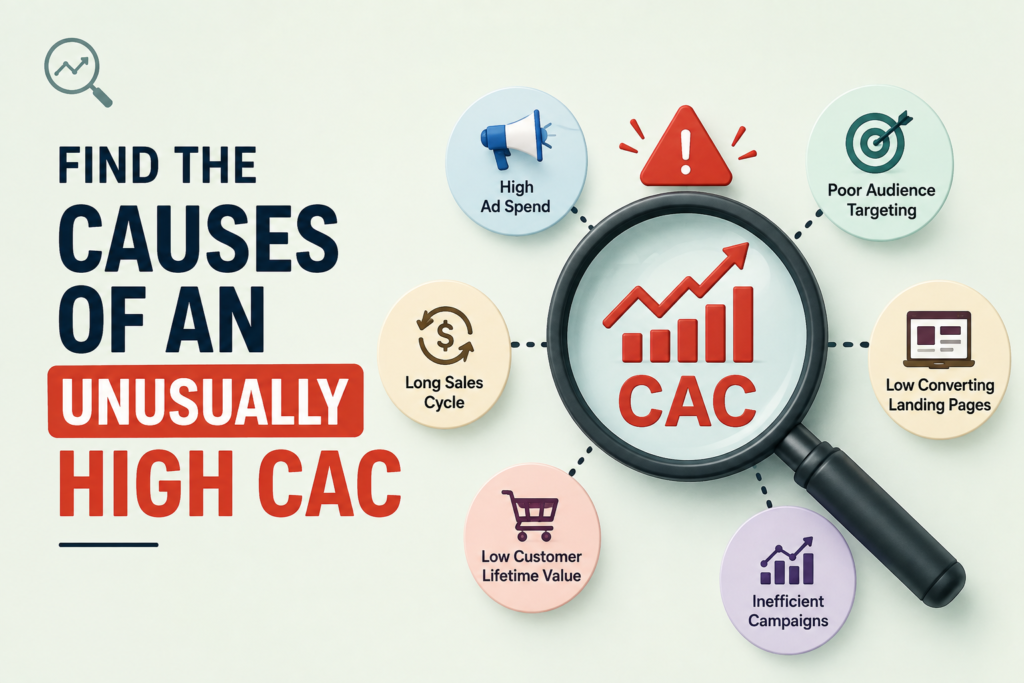
When your marketing expenses climb unexpectedly, you need a structured approach to find the root cause. A high customer acquisition cost often signals that your current strategy is hitting a wall, but it does not always mean the channel itself is broken. Before making changes, review how to calculate acquisition cost to ensure the underlying figures are accurate. By following a diagnostic framework, you can isolate the specific variables that are inflating your spending.
Identify Weaknesses in Targeting and Audience Qualification
The first step in your CAC analysis is to evaluate who you are reaching. If your ads are served to broad or irrelevant audiences, you will pay for clicks that never turn into customers. You must ensure that your targeting parameters align with your ideal customer profile.
Poor audience qualification often leads to wasted ad spend. If your messaging attracts users who lack the budget or the need for your product, your conversion rates will inevitably suffer. Refining your audience segments is a quick way to lower costs and improve lead quality.
Locate Conversion Losses Across the Marketing and Sales Funnel
A drop in marketing funnel conversion is a common culprit for rising costs. You should map out every stage of your funnel to identify where potential customers are dropping off. A high bounce rate on a landing page or a slow checkout process can inflate your costs significantly.
Check for friction points that prevent users from completing their purchase. If your sales team is involved, look for delays in lead follow-up or poor communication during the nurturing phase. Even a small improvement in conversion at each stage can lead to a substantial decrease in your overall acquisition expense.
Separate Rising Media Costs From Internal Process Problems
It is vital to distinguish between external market shifts and internal inefficiencies. Sometimes, a high customer acquisition cost is simply the result of rising media prices, such as increased CPMs on platforms like Meta or Google. These external factors are often outside of your direct control.
However, internal issues like weak offers, poor creative assets, or slow website load times are entirely within your power to fix. If your media costs remain stable but your performance drops, focus your efforts on optimizing your internal processes. Do not blame the market for problems that you can solve with better creative or a more compelling value proposition.
Review Attribution Changes Before Concluding That CAC Increased
Before you make drastic changes to your budget, verify that your data is accurate. Attribution models often change, and updates to tracking software can make your performance appear worse than it actually is. A shift in how you define a “conversion” can artificially inflate your reported costs.
Always check your tracking pixels and CRM integrations for errors. If you recently updated your analytics platform, compare the new data against historical benchmarks to ensure consistency. You might find that your performance has not changed at all, but rather the way you measure it has evolved.
Reduce CAC Without Sacrificing Customer Quality
Achieving sustainable growth means you must learn how to reduce CAC effectively. When you focus on efficiency, you ensure that your marketing dollars work harder to bring in high-value clients. A sound customer acquisition strategy balances aggressive growth with long-term financial health.
Improve Audience Targeting and Exclude Low-Value Traffic
Start by refining your audience segments to focus on users with the highest intent. You can exclude demographics or interests that historically show low engagement or high churn rates. By narrowing your focus, you stop wasting budget on clicks that never convert into meaningful revenue.
Increase Landing Page and Checkout Conversion Rates
Small changes to your digital storefront often yield significant results. When you understand how to calculate acquisition cost, you can measure the financial impact of these conversion improvements more clearly. Use A/B testing to simplify your checkout flow and remove unnecessary form fields. A frictionless experience encourages users to complete their purchase, which helps you calculate cost per acquisition more accurately by increasing your total conversion volume.
Strengthen Creative, Offers, and Message-Market Fit
Your marketing message must resonate deeply with your target audience’s pain points. When your creative assets align perfectly with your offer, you attract higher-quality leads. This alignment reduces the friction between initial interest and final purchase.
Use Retargeting, Email, and Organic Channels Efficiently
Paid ads are not the only way to grow your business. You can leverage email marketing and organic content to nurture leads who are not yet ready to buy. These channels often have a lower cost than top-of-funnel paid media, helping you reduce CAC over time.
Improve Sales Qualification and Shorten the Buying Process
If you have a sales team, ensure they are only spending time on qualified leads. Use automated lead scoring to prioritize prospects who show high intent. Shortening the sales cycle prevents your team from wasting resources on prospects who are unlikely to close.
Run Controlled Tests and Reallocate Budget to Efficient Channels
Never scale a campaign without testing it first. Run small, controlled experiments on your bidding strategies, landing pages, and messaging. Once you identify a winning combination, shift your budget away from underperforming channels to maximize your return on investment.
Measure Incremental Customers Rather Than Relying Only on Platform Reports
Platform reports often take credit for sales that would have happened anyway. You should focus on measuring incremental customers to understand the true impact of your ads. This approach provides a clearer picture of your actual customer acquisition strategy performance.
Protect Retention and Customer Quality While Lowering Acquisition Spend
Lowering your costs should never come at the expense of customer lifetime value. Knowing how to calculate acquisition cost helps you balance lower spending with the need to maintain valuable, long-term customers. Monitor your retention rates closely as you optimize your spending. If you notice a drop in quality, you may need to adjust your targeting to ensure you are still attracting the right type of user.
| Strategy | Primary Benefit | Impact on CAC |
|---|---|---|
| Audience Refinement | Higher Intent | Significant Decrease |
| Conversion Optimization | More Sales | Moderate Decrease |
| Organic Nurturing | Lower Cost | Long-term Decrease |
To successfully reduce CAC, you must maintain a disciplined approach to data. That discipline starts with knowing how to calculate acquisition cost consistently and accurately. Always verify your results against your CRM data to ensure your efforts are truly driving profitable growth.
Make Every Marketing Dollar Work Harder
Get better visibility into your acquisition performance and make confident decisions about your marketing budget. Visit our homepage to discover smarter growth solutions.
Conclusion
Calculating your acquisition cost requires dividing total marketing and sales spending by the number of verified new customers. This simple math provides a clear window into your business health when you use consistent measurement periods and complete expense data.
You gain the most value by comparing these figures against gross margin and customer lifetime value. Knowing how to calculate acquisition cost gives you the foundation for making this comparison accurately. Relying on revenue alone often hides the true cost of growth. Using an acquisition cost calculator helps you track these trends across different channels and campaigns with precision.
Make it a habit to review your data through an acquisition cost calculator to spot unexpected spikes in spending. Investigate these changes early to protect your bottom line. You can improve your efficiency and scale your operations without sacrificing the quality of your customer base.
Take control of your financial performance by auditing your attribution models today. Knowing how to calculate acquisition cost correctly makes these attribution audits more meaningful and actionable. Consistent monitoring ensures your marketing budget works as hard as possible for your brand. Start refining your strategy now to build a sustainable path toward long-term profitability.
FAQs
What is the primary formula used to learn how to calculate acquisition cost?
To determine your Customer Acquisition Cost (CAC), you must divide your total marketing and sales expenses by the number of new customers acquired during a specific timeframe. For example, if your Shopify store spends ,000 on Google Ads and sales labor in a month to gain 100 new customers, your CAC is . Using a cost per acquisition calculator regularly ensures you are tracking these metrics against your actual business growth.
How does a customer acquisition cost calculator differ from a cost per lead tool?
While a lead calculator measures the cost to get someone into your funnel, a customer acquisition cost calculator focuses strictly on the final conversion: the paying customer. CAC accounts for all combined costs—including Salesforce subscriptions, marketing payroll, and ad spend—whereas Cost Per Lead (CPL) or Cost Per Action (CPA) usually only looks at the initial marketing trigger. You should use a calculate cost per acquisition approach to see the full financial picture of your sales cycle.
Which specific expenses should you include in an acquisition cost calculator?
For an accurate result, your acquisition cost calculator should include all “loaded” costs. This means adding up your Meta Ads spend, content production fees, agency retainers, and the salaries or commissions of your sales team. If you are a SaaS company like HubSpot, you must also include the cost of the software tools used to manage the acquisition process. Failing to include payroll or overhead will result in an artificially low CAC.
Why is it important to compare CAC with Customer Lifetime Value (LTV)?
Calculating your CAC in isolation doesn’t tell the whole story; you need to know if the customer is worth the investment. A healthy business model typically aims for an LTV:CAC ratio of 3:1, meaning the customer provides three times more value over their lifetime than it cost to acquire them. If your calculate cost per acquisition result is higher than the gross margin you earn from that customer, your business model may be unsustainable in the long run.
How can you reduce your CAC without lowering the quality of your customers?
To lower costs efficiently, focus on improving your conversion rate optimization (CRO) on landing pages and tightening your audience targeting in Google Analytics. By excluding low-value traffic and refining your message-market fit, you spend less to find the right buyers. Additionally, strengthening your organic reach through SEO and utilizing automated email retargeting can significantly bring down the average cost per customer compared to relying solely on paid media.
What is the difference between blended CAC and channel-specific CAC?
Blended CAC looks at your total marketing spend across all platforms (organic, paid, referral) to give you an overall average. In contrast, channel-specific CAC isolates spending on a single platform, such as LinkedIn Ads, to see how that specific investment performs. Most professional marketers use a customer acquisition cost calculator to compare these figures, allowing them to reallocate budget from high-cost, low-performing channels to those that offer a better return on investment.
How do attribution models change the way you calculate cost per acquisition?
Your choice of attribution, whether it is first-touch, last-touch, or multi-touch—can change which channel gets the “credit” for a sale. If you use a last-touch model, your search ads might appear to have a lower CAC, while a first-touch model might favor your social media awareness campaigns. To get the most accurate data, ensure your acquisition cost calculator matches the data in your CRM to avoid duplicating customer counts or missing costs associated with a long sales cycle.
1 thought on “How to Calculate Acquisition Cost: Formula, Examples, and Ways to Reduce CAC”